Lens Fungus: How to Spot It, Stop It, and Whether to Buy Affected Glass
Lens fungus shows up as a soft, branching, web-like pattern — think fine roots or…

The fastest way to test whether a lens is decentered is to mount it on a tripod, aim it square-on at a flat textured wall, shoot wide open, and compare the four corners at full magnification — if one corner stays soft and never catches up as you stop down, an element group has shifted off-axis. I run exactly this flat-wall check on every lens I bring home, because on my 40-megapixel X-T5 a decentered corner has nowhere to hide. The test takes ten minutes, needs no chart, and tells you in one frame whether the lens is healthy or needs to see a technician.
This is the mechanical-health companion to the broader lens care pillar. Where that guide covers fungus and dust and storage, this one is about the single defect most likely to appear after a knock — and about telling a genuinely decentered lens apart from the field curvature and focus-placement quirks that merely look like one.
A modern lens is a precision stack of glass elements held in a machined barrel, with each group positioned to a tolerance measured in microns. Decentering happens when one of those groups shifts fractionally off the optical axis — tilted, raised, or lowered relative to the others — usually because of an impact, a drop, a hard bag-slam, or simply long wear on the helicoids of a heavy zoom. Once a group is off-axis, the light cone no longer converges symmetrically, and one part of the frame is rendered soft while the opposite part may stay sharp or even overshoot.
The defining behavior of decentering is asymmetry. A lens that is merely soft in the corners — because it is a budget optic, or because you are shooting wide open — goes soft roughly evenly on both sides. A decentered lens goes soft on one corner or one side specifically, and the softness is directional: top-left soft while bottom-right is crisp, for example. That left-versus-right or top-versus-bottom mismatch is the fingerprint that separates a genuine alignment defect from an ordinary lens that is just not at its best wide open.
A decentered corner does not behave like ordinary corner softness, and learning to read the difference is most of the diagnostic. Ordinary softness improves steadily as you stop the lens down — by f/5.6 or f/8 the corners of a healthy lens have tightened up considerably as depth of field covers the field curvature. A decentered corner improves far less, or not at all, because the problem is geometric misalignment rather than aperture-limited depth of field. The light is landing in the wrong place, and stopping down cannot move it back.
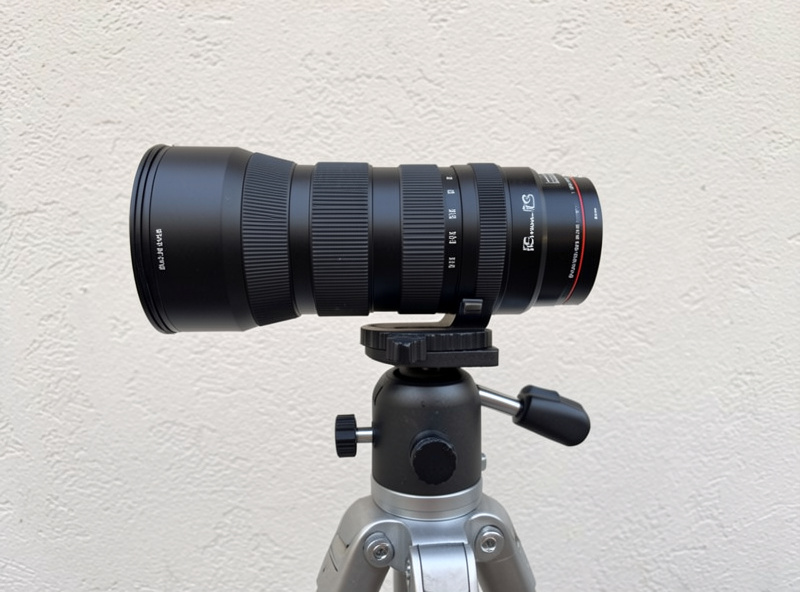
The other tell is consistency. If the soft corner is always the same corner, at every focal length on a zoom and at every focus distance, the lens is decentered. If the soft corner moves around — soft on the left when focused close, soft on the right when focused far — you are more likely looking at field curvature interacting with your focus plane, which is a lens characteristic rather than a defect. Field curvature is the natural bowl-shape of a lens’s plane of focus; it is normal, it varies by design, and it is the reason flat-wall testing can mislead you if you do not account for it. It is a well-documented aberration — Petzval field curvature — that every lens design fights to some degree, and no amount of stopping down truly flattens it. The sharpness and aberrations guide explains field curvature in depth if you want the optical background.
Here is the exact procedure I use, and it requires nothing you do not already own: a tripod, a lens, and a flat wall with fine, even texture — brick, stucco, or a wall covered in taped-up newspaper all work. The point of the texture is to give every corner of the frame the same fine detail to resolve, so any softness is the lens and not the subject. Do not use a printed resolution chart for this first pass; a chart is great for measuring sharpness but a plain flat surface is better for finding asymmetry.

Set the camera on a sturdy tripod and level it carefully — use the bubble level or the camera’s electronic level, because if the camera is tilted relative to the wall you will read tilting focus as decentering. Square the camera to the wall so the sensor plane is parallel to the surface, not angled. Set the lens to its widest aperture, focus dead center using a single AF point or manual focus with magnification, and use a shutter speed fast enough or a shutter delay to rule out shake. Shoot one frame wide open, then shoot again at f/4, f/5.6, and f/8 without changing the framing. Load the images and crop tightly into each of the four corners at full magnification, then compare them side by side. On a zoom, repeat the test at the wide end, the middle, and the long end, because decentering can appear at one focal length and not another.
The most common mistake in this test is calling a lens decentered when it is only showing focus-placement error — that is, the plane of sharpest focus is slightly in front of or behind the wall, so the whole frame looks soft even though the lens is perfectly aligned. The fix is to confirm focus first: take a frame, then nudge focus slightly forward and back, and check whether some aperture makes all four corners sharpen together. If the corners all sharpen when you fix the focus plane, the lens is not decentered; it may simply need the AF calibration covered in the back-focus and front-focus guide.
The second false alarm is field curvature misread as a soft corner. If your wall is large and flat but the lens has strong curvature, the center of focus bites into the wall while the curved edges fall in front of or behind the surface, softening the corners symmetrically. Symmetric softening that improves with stopping down is field curvature, not decentering. The true decentering signal is asymmetric, persistent, and locked to one corner — and it is the only one of these problems that means the lens needs to go to a tech.
Decentering is almost never a home fix. Recollimating an element group means opening the barrel, loosening the adjustment collars, shimming or rotating the offending group back onto the optical axis, and re-torquing everything to spec — work that calls for a collimator, clean-room conditions, and experience. A competent independent technician can do it on most lenses for a fraction of the replacement cost, and on premium glass it is almost always worth doing. On a cheap kit zoom with a major decenter, the service quote often exceeds the lens’s value, and replacement is the rational call.
If the test reveals a consistent front-focus or back-focus instead of an asymmetric corner, that is good news: it is usually correctable at home through the body’s AF micro-adjustment or a manufacturer’s USB dock, with no service invoice at all. For the broader context of how a lens’s optical design affects what you can expect corner-to-corner, the camera lens guide and the prime versus zoom comparison are worth reading next — and the full care routine sits in the lens care pillar.
Mount the lens on a tripod, aim it square-on at a flat textured wall, shoot wide open, and compare the four corners at full magnification. If one corner stays soft and does not catch up as you stop down to f/5.6 or f/8, the lens is likely decentered.
No. Symmetric softness that improves as you stop down is usually ordinary corner softness or field curvature. True decentering is asymmetric, affects one corner or side specifically, and persists even when the lens is stopped down.
Almost never. Recollimation requires opening the barrel, adjusting and shimming element groups back onto the optical axis with a collimator, and re-torquing to spec. It is clean-room work for a technician, not a home repair.
Strong field curvature can make a lens look soft on a flat target because its curved focus plane does not match the flat wall. If the softness is symmetric and clears up when you stop down, it is field curvature, a normal characteristic rather than a defect.
It can. A minor shift from a knock may stay stable for years, but further impacts or heavy zoom use can move the element group more. If a corner that was borderline softens further between tests, send the lens for recollimation before it worsens.

Lens fungus shows up as a soft, branching, web-like pattern — think fine roots or…

Lens care comes down to three fights: keeping the optical glass free of fungus and…
Leave a Reply