How to Take Care of Camera Lenses
Lens care comes down to three fights: keeping the optical glass free of fungus and…
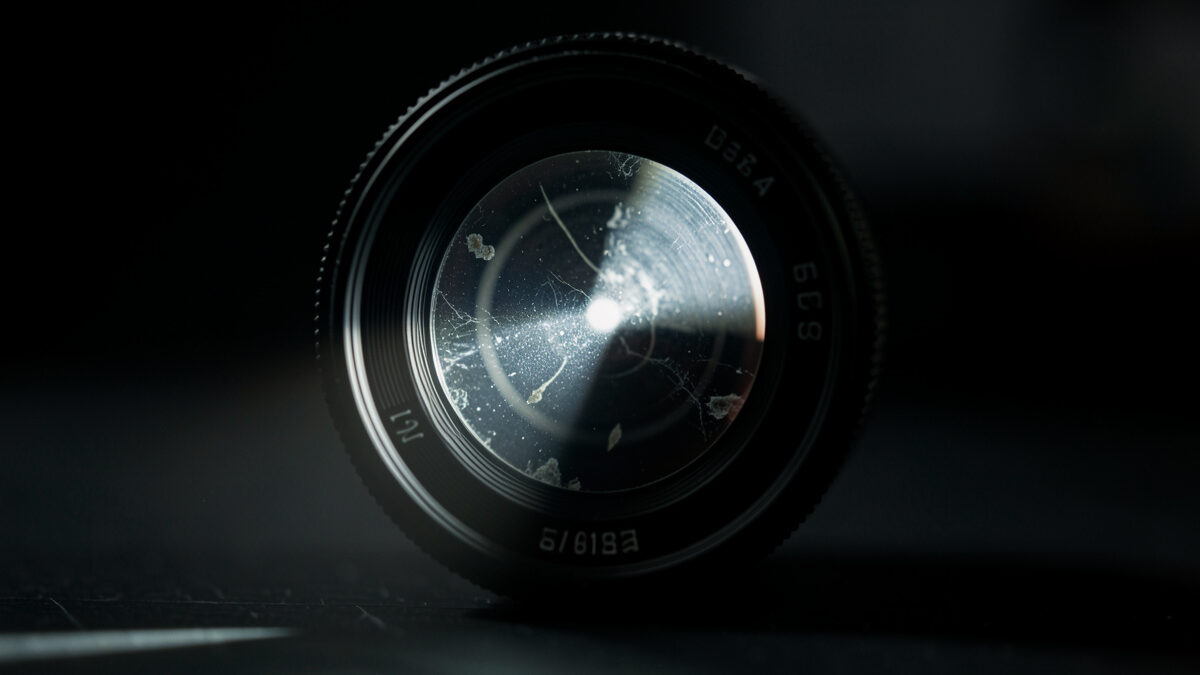
Lens fungus shows up as a soft, branching, web-like pattern — think fine roots or frost — growing across an internal glass surface, and the only reliable way to find it is to shine a focused light through the lens in a dark room and look for that feathery tracery. On my 40-megapixel X-T5 I inspect every used lens this way before I trust it, because once fungus has etched the coating the damage is permanent. The good news is that identifying lens fungus is a thirty-second flashlight test, and stopping it is entirely a matter of humidity control.
This guide is the deep dive on fungus specifically — how to tell it apart from haze, dust, and separation, what conditions let it take hold, whether a tech can reverse it, and how I decide whether a fungused lens is worth buying. It sits underneath the broader lens care pillar, which covers the full maintenance picture.
Lens fungus is exactly what it sounds like: a real fungal organism, usually a mold from the Aspergillus or Penicillium families, that has colonized the inside of a lens. A spore drifts in through a gap, a focus-extension seam, or an uncapped rear element, finds the layer of microscopic dust and skin oil that accumulates on internal glass over years of use, and — given enough moisture — begins to grow. What you see through the glass is its mycelium, the branching root-structure of the colony, spreading slowly across the element.
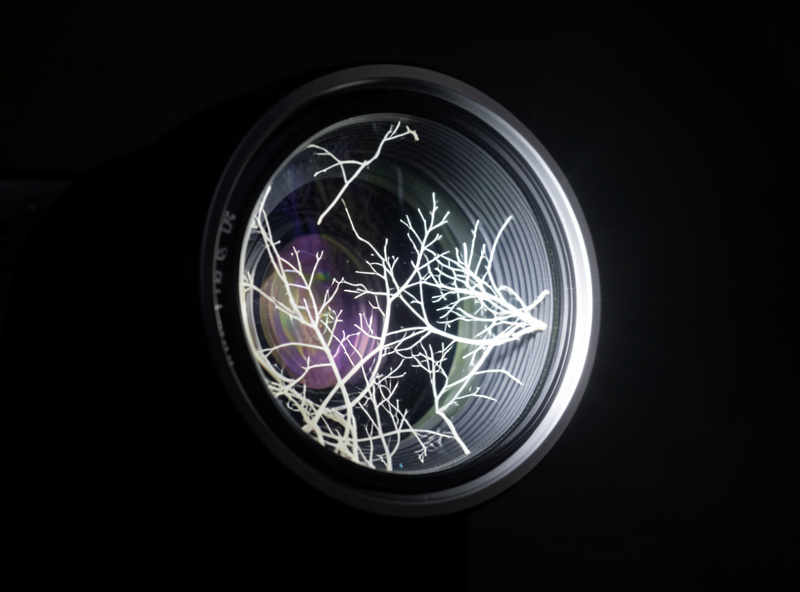
Three things separate fungus from every other internal defect. First, it grows: a dust speck sits where it sits forever, but a fungus colony spreads over weeks and months, so a pattern that was barely visible in spring can be unmistakable by autumn. Second, it is organic and irregular — the threads branch and fork like roots or a river delta, never the neat circular blobs of condensation or the flat gray film of haze. Third, it tends to start at the edge of an element near the spacer rings, where dust and oil collect, and work inward. If what you see matches that description, you are almost certainly looking at fungus rather than dust or lubricant haze.
You do not need any specialized gear to find lens fungus — a small LED flashlight or penlight and a dim room are enough. The method is the same one I use to inspect every used lens I bring home, and it takes about half a minute once you have done it a few times. The goal is to send a focused beam through the glass so that any contamination on the internal elements catches the light against a dark background.

Here is the exact sequence. Take the lens off the body and cap nothing. In a darkened room, hold the lens so you can look through the rear element toward a light source, then shine the flashlight in at a shallow angle from the front — almost parallel to the glass, not straight at it. Rock the lens slowly and let the beam sweep across each internal element. Dust shows up as sharp, distinct specks that do not move relative to the glass; lubricant haze shows up as a uniform gray or bluish film; fungus shows up as that branching, root-like web that seems to grow across the surface. Repeat from the rear with the light coming through the front. If you see feathery branching lines, especially clustered near the edge of an element, that is fungus. A cheap bright penlight is all the tool this takes.
Fungus cannot grow without sustained moisture, which makes humidity control the entire prevention strategy. The threshold I aim for is between 40 and 55 percent relative humidity — low enough that no spore can colonize, but not so dry that it stresses older lubricants or balsam-cemented vintage elements. Above about 60 percent RH, sustained for weeks, a lens with a spore inside is on borrowed time; above 70 percent, colonization is almost a matter of when, not if. This is why fungus is overwhelmingly a problem in tropical, coastal, and seasonally damp climates rather than dry ones.
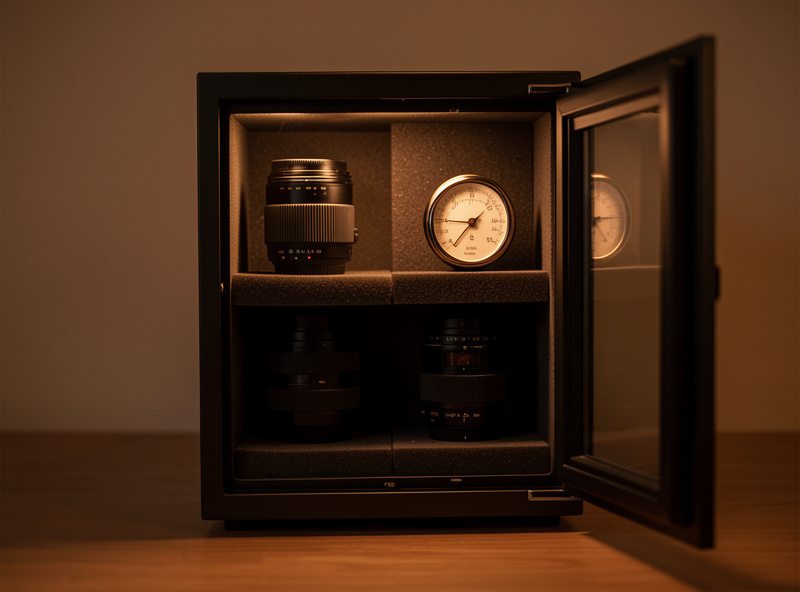
In practice that means storing your best glass in a sealed environment held at the right humidity. A small electronic dry cabinet set around 45 percent RH is the cleanest solution for a working kit, and for everything else an airtight box with rechargeable silica packs does the job as long as you bake the packs dry every couple of months. The full method — including how to read a hygrometer, where to place a cabinet, and why the door seal matters more than capacity — is in the humid-climate storage guide. As an Amazon Associate I earn from qualifying purchases. The other half of prevention is keeping spores out in the first place: cap the rear element the instant a lens leaves the mount, and avoid changing lenses in genuinely dusty, damp conditions when you can.
Whether fungus can be removed depends entirely on how long it has been growing. Caught early — when the colony is a faint tracery that has not yet bonded with the coating — a competent tech can strip the lens down, clean the affected element, and reassemble it for a fraction of the lens’s value. The colony dies the moment the humidity drops, so even an active infection stops spreading once the lens is in dry storage, which buys you time. Early cleaning is genuinely worth doing on good glass.
The line you do not want to cross is etching. As the fungus feeds and grows it secretes mild acids that slowly dissolve the anti-reflective coating beneath it, and after enough time the coating is gone for good in the shape of the colony. A cleaned-but-etched lens is usable but compromised: the bare patches flare more, lose a little contrast, and can never be restored short of re-coating the element, which is almost never economical. This is why the flashlight test matters — the earlier you catch it, the more of the lens you save. If you want to understand what those flare and contrast losses actually look like in an image, the sharpness and aberrations guide covers how coating defects render.
My rule is to buy a fungused lens only at a price that already assumes the worst, and only when I am prepared to lose the glass entirely. A lens with a small, early, edge-of-element colony on an inexpensive prime might be worth a gamble if the discount is steep and you have a trustworthy tech — cleaned early, it can give years more service. A lens with widespread, central, well-established fungus on a premium optic is almost always a pass, because the odds of etched coating and the cost of a full strip-down eat the discount. Fungus is also contagious in the sense that a colony shedding spores can seed your other gear, so any fungused lens should be quarantined from clean glass until it has been serviced.
For the broader inspection checklist — haze, separation, oil on the blades, balsam aging — the used-lens inspection guide walks through every defect to check before money changes hands. And because the same humid storage that prevents fungus also keeps dust and coatings healthy, the related dust-and-image-quality guide and the fingerprint cleaning guide round out the external-glass side of the same care routine.
Lens fungus looks like a soft, branching, web-like pattern growing across an internal glass surface, similar to fine roots, frost, or a river delta. It is irregular and organic, unlike the sharp dots of dust or the flat gray film of haze, and it tends to start near the edge of an element.
Yes. A fungal colony sheds spores, so a lens with active fungus can seed your other gear if they share storage. Quarantine any fungused lens in its own dry, sealed container away from clean glass until a tech has cleaned it.
Fungus colonizes lenses above roughly 60 percent relative humidity sustained over weeks, and growth is almost certain above 70 percent. Storing lenses between 40 and 55 percent RH removes the moisture the organism needs and effectively prevents it.
Early fungus is invisible in images. Once it etches the coating or becomes heavy, it can lower contrast and add flare, but it rarely shows as a visible shape in the frame. The real cost is reduced optical quality, not a visible defect on the print.
Only at a steep discount and only if the fungus is early and near the edge of an element. Widespread or central fungus on a premium lens usually means an etched coating and a costly strip-down, so pass unless the price already assumes the worst.
Lens care comes down to three fights: keeping the optical glass free of fungus and…

The fastest way to test whether a lens is decentered is to mount it on…
Leave a Reply