Off-Camera Flash for Beginners: Your First Wireless Flash Setup
Why Off-Camera Flash Changes Everything Taking your flash off the camera gives you control over…
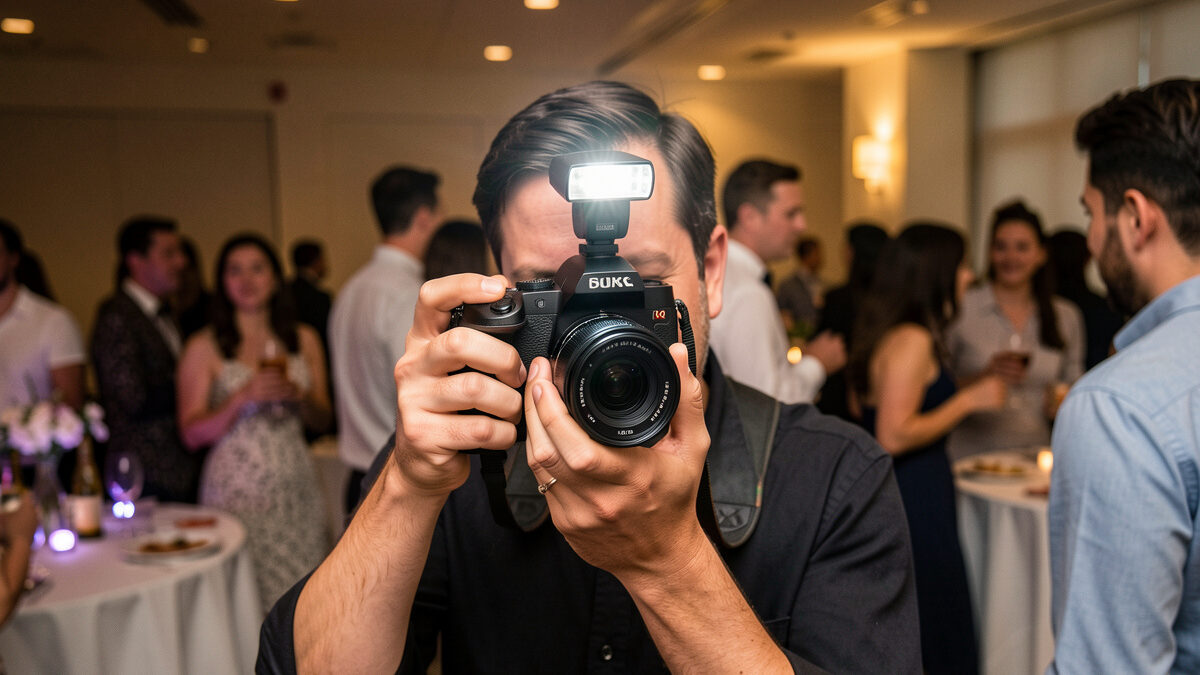
On-camera flash gets a bad reputation it only half deserves. Pointed straight ahead, the built-in or hot-shoe flash flattens faces and casts ugly shadows — but aimed at a ceiling and bounced, that same flash becomes a large, soft overhead source that flatters almost any indoor scene. The single most useful on-camera flash skill is bouncing, and it turns a harsh point of light into something that looks like window light.
I am a natural-light shooter by preference, but I keep a Godox V1 on the X-T5’s hot shoe for exactly the situations daylight cannot reach: a dim dinner, an indoor event, a product on a workbench at midnight. I chose the V1 specifically for its round head and full tilt-and-swivel, because bouncing is the entire game and a head that only tilts straight up gives up half the technique. The trick is never letting the flash announce itself. This guide is the on-camera workflow I actually use, built so a beginner can get clean, natural-looking flash on the first evening rather than the tenth.
Direct on-camera flash fails for one structural reason: the light comes from right beside the lens. That on-axis position throws the subject’s shadow directly behind them, out of view, so the face looks flat and shadowless — no modeling, no sense of shape. It also produces a hard, hot specular highlight on skin and that hard-edged shadow on any nearby wall. Add red-eye from the light bouncing off the retina, and you have the classic snapshot look.
None of this is the flash’s fault — it is the position and the hardness. Fix those two things and on-camera flash becomes genuinely useful. The fix for position is bouncing; the fix for hardness is a larger effective source. Both are free or nearly so, and both are the whole reason a hot-shoe flash earns its place in the bag.
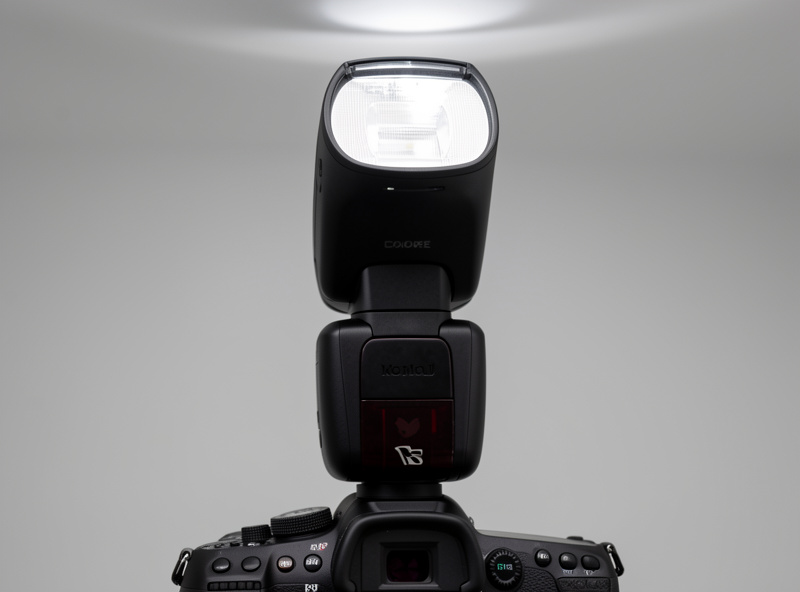
Bouncing means tilting and swiveling the flash head so the light hits a wall or ceiling first, then falls onto your subject as a large, diffuse source. The reflecting surface becomes the actual light — and because it is enormous relative to the subject, the light is soft and wrapping. A white ceiling about two to three meters up is the easiest win in all of flash photography: tilt the head to roughly 45 to 60 degrees, fire, and the room fills with even, flattering light.
Direction still matters when you bounce. Straight up gives soft but slightly top-heavy light with shadows under the eyes; tilting the head back over your shoulder to bounce off a wall behind you pushes the light forward and down, which is more flattering for faces. Bouncing off a side wall gives directional, almost off-camera-looking light from a flash that never left the hot shoe. I move around the room reading surfaces the same way I read daylight — where is the big soft reflector, and how do I put my subject in its path?
Bounce has limits, and knowing them saves you from chasing a technique that cannot succeed in the room you are standing in. High ceilings — a church, a warehouse venue, anything much above three or four meters — eat too much light before it returns, leaving you cranking power and draining batteries for little result. Colored ceilings and walls are worse: bounce off a warm wood ceiling and your subjects turn orange; off a green wall and skin goes sickly. The reflecting surface paints its color onto your light. I learned that one the hard way at a friend’s dinner under a pine-clad ceiling — every face came back tangerine and no white-balance trick fully rescued them; now I check the ceiling color before the head ever tilts up.
In those rooms you have two options: switch to a small on-camera diffuser or bounce card that throws a little soft light forward directly, or get the flash off-camera entirely. When the room fights me, I reach for the off-camera setup — the full method is in my off-camera flash setup guide, and the beginner-friendly wireless version is covered in the existing off-camera flash for beginners walkthrough.
For run-and-gun on-camera work — events, gatherings, anything where your distance to the subject keeps changing — TTL is the right mode. The camera fires a pre-flash, meters the scene, and sets flash power automatically, frame to frame. It is not perfect, but it is fast, and for moving situations it keeps you in the action instead of dialing power between every shot.
The one control you will use constantly with TTL is flash exposure compensation (FEC). If TTL is making faces too bright, dial in -0.7 or -1 stop; if subjects come out dark against a bright background, push +0.7. I almost always run a touch of negative FEC for bounce work, because a little flash that fills shadows without overpowering the ambient looks far more natural than full-strength flash that flattens the room. Here is how the common on-camera scenarios break down.
| Scenario | Technique | Mode & setting |
|---|---|---|
| Low white ceiling indoors | Bounce straight up or over shoulder | TTL, FEC -0.3 to -0.7 |
| High or colored ceiling | Bounce card or small diffuser forward | TTL, FEC 0 to +0.3 |
| Fast-moving event | Bounce, keep shooting | TTL for speed |
| Posed portrait at a table | Bounce off side wall | Manual for consistency |
| Outdoor fill in shade | Direct flash, dialed down | TTL, FEC -1 to -1.3 |
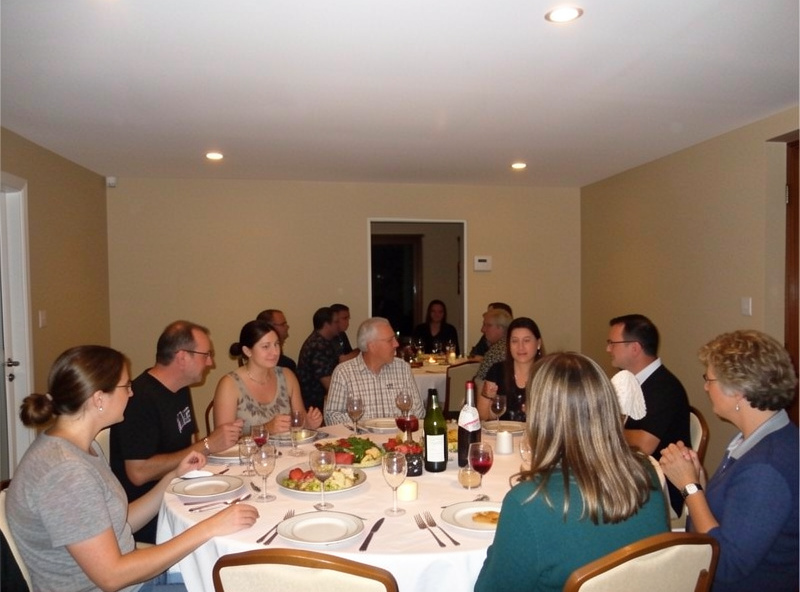
The on-camera flash trick I lean on most is not for dark rooms at all — it is daylight fill. On a harsh sunny day, faces fall into deep shadow under hats and brows, and backlit subjects turn to silhouette. A touch of direct on-camera flash, dialed well down with negative FEC, lifts those shadows just enough to keep detail without looking lit. The sun stays the key light; the flash is only cleaning up after it.
Outdoors there is no ceiling to bounce from, so this is one of the few times direct on-camera flash is the right call — you want a small, controlled amount of frontal fill, not a soft wash. Keep it subtle. If anyone can tell you used flash, you used too much. This pairs naturally with knowing how to read and shape daylight in the first place, because fill flash is a daylight technique that happens to use a flash.
The most common on-camera flash failure indoors is not the light on the subject — it is the dead black background behind them. That happens when a fast shutter speed shuts out all the ambient light and only the flash registers. The cure is dragging the shutter: deliberately slowing the shutter speed (often to 1/30 or 1/15 second) so the camera collects the room’s ambient glow, while the flash freezes the subject sharp.
The result looks far more natural — warm window light or candlelit atmosphere stays in the frame, and the flashed subject sits inside that environment instead of floating in a void. The catch is camera shake and subject motion at slow shutters, so brace yourself, use a steady hand or a wall, and accept a little ambient motion blur as part of the look. This is the same balance-the-ambient-first logic that governs all good flash work, applied with the camera on your shoulder. Enabling rear-curtain sync here keeps any motion trails flowing behind a moving subject rather than ahead of them.

You need less than you think. A speedlight with a tilting, swiveling head is the non-negotiable — the pop-up flash on the camera cannot bounce, which is why it almost always looks bad. Beyond that, a small bounce card (many flashes have one built in) and a clip-on diffuser cover the high-ceiling cases. That is genuinely the whole on-camera kit.
As an Amazon Associate I earn from qualifying purchases.
Look for a speedlight with a tilt and swivel head that matches your camera’s TTL system, and add a cheap flash diffuser and bounce card for the rooms where the ceiling will not cooperate. For help choosing a unit, my best speedlights for mirrorless roundup compares the options worth buying. When you are ready to take the flash off the hot shoe, the complete photography flash guide maps out where to go next.
The flash fires from right beside the lens, on-axis, so shadows fall directly behind the subject and the face loses all modeling. Tilt the flash head up and bounce it off a white ceiling instead, and the light becomes large, soft, and directional.
Tilt the flash head to about 45 to 60 degrees so the light hits the ceiling and falls back onto your subject as a broad soft source. Works best with a white ceiling around two to three meters high. Tilting back over your shoulder pushes light more flatteringly forward.
Use TTL for fast, changing situations like events where subject distance varies, since it sets power automatically each frame. Use manual for posed shots where you want identical exposures. Add flash exposure compensation in TTL to fine-tune brightness.
Avoid it. The reflecting surface casts its color onto your light, so a wood ceiling turns subjects orange and a green wall makes skin look sickly. Use a forward-facing diffuser or bounce card instead, or take the flash off-camera.
Yes, for daylight fill. A small amount of direct flash dialed down with negative flash exposure compensation lifts shadows under hats and brows or rescues backlit subjects. The sun stays the key light and the flash only cleans up the shadows.
You need a hot-shoe speedlight with a head that tilts and swivels. The built-in pop-up flash cannot bounce, which is exactly why it almost always looks harsh and flat. A bounce-capable speedlight is the single piece of gear that makes on-camera flash work.
Why Off-Camera Flash Changes Everything Taking your flash off the camera gives you control over…
Natural light is the cheapest professional-grade light source you will ever have access to, and…
Why Size Matters: The Physics of Soft Light The softness of light is determined by…
Leave a Reply