On-Camera Flash Guide for Beginners: Bounce It Right
On-camera flash gets a bad reputation it only half deserves. Pointed straight ahead, the built-in…
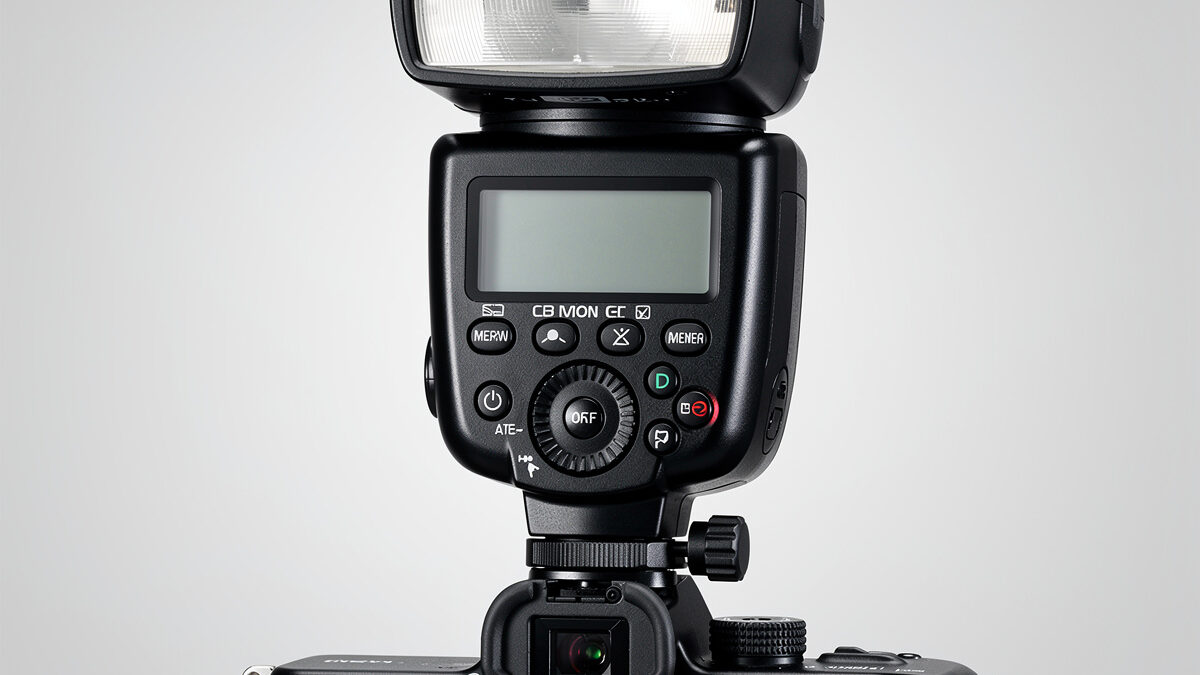
Finding the best speedlights for mirrorless cameras is about matching flash features to your actual shooting workflow rather than chasing the highest guide number. A speedlight is the most accessible artificial light source for photography — it costs between $100 and $400, fits in a pocket, and produces enough light to fill shadows at noon, light an entire room bounced off a ceiling, or freeze fast action at 1/10,000 second. A good speedlight is the first lighting purchase I recommend after mastering natural light; it extends your shooting capability into situations where sunlight is not enough, not available, or not flattering.
What follows is what I have learned about speedlights shooting mirrorless cameras. Not a spec sheet comparison — a practical guide to the features that matter, the ones that do not, and which speedlights deliver the most value for mirrorless shooters.
Guide number measures the maximum light output of a speedlight at a given ISO and focal length — a GN of 60 (meters at ISO 100, 200mm zoom) is roughly twice as powerful as a GN of 42. The ISO 1230 standard defines how manufacturers should measure guide number — meters at ISO 100, full power against a calibrated reflectance target under specified room conditions — so a GN reported per spec is meant to be comparable across brands. Budget brands sometimes inflate their headline GN by measuring at a zoomed focal length (105mm or 200mm) where the flash beam is narrower and the apparent reach is higher, which is why a “GN 60” from one brand can be noticeably weaker in bounce use than a “GN 60” from a brand that reports honestly. For bounced flash indoors, a GN of 36 to 42 is sufficient for most rooms with 8- to 12-foot ceilings. For outdoor fill flash competing with direct sun, a GN of 50 to 60 gives you the power to overpower ambient light at reasonable working distances.
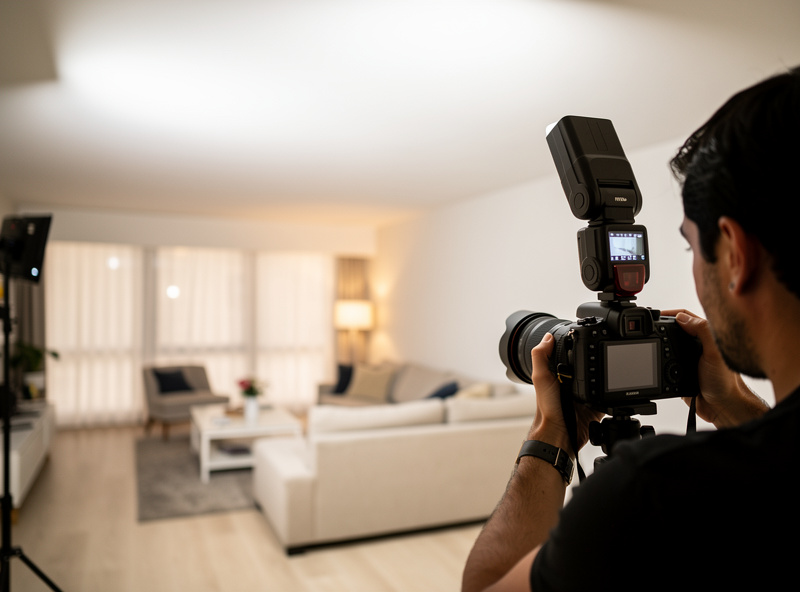
Most mirrorless shooters do not need the highest guide number — a GN 42 speedlight bounced indoors is bright enough, and outdoor fill flash at typical portrait distances (6 to 10 feet) works with GN 42 if the flash is positioned correctly.
Recycle time is the delay between full-power flashes while the capacitors recharge. A speedlight that recycles in 1.5 seconds at full power lets you shoot roughly 40 frames per minute with flash. A speedlight that recycles in 4 seconds drops that to 15 frames per minute. For event photography where moments happen in rapid succession, recycle time is the most important speedlight specification. For portrait and product work where you shoot deliberately, recycle time matters less. External battery packs reduce recycle time by feeding more current to the capacitors, but they add bulk and a cable that can snag — they are tools for event photographers who need sustained rapid fire, not for the photography most of us do. After 8 to 10 full-power pops in succession, a Godox TT600 housing gets noticeably warm to the touch, and the capacitor whine between shots drops from a high rising tone to silence as the green ready-light returns. That whine is the most-asked-about sound at a portrait session — subjects always notice it on the second pop, and explaining that the flash is just recharging usually relaxes them.
Wireless compatibility determines whether the speedlight works off-camera with your camera system. Every major system — Canon, Nikon, Sony, Fuji — has a proprietary wireless flash protocol, and a speedlight must support your specific system to work as a wireless slave. Third-party manufacturers like Godox, Yongnuo, and Nissin build speedlights with built-in radio receivers that work across systems with the matching transmitter. A Godox TT685II-S works as a radio slave with Sony cameras, and the same flash in the Canon version works with Canon. The radio receiver is built into the flash — no external receiver needed — and the $50 transmitter controls power, zoom, and groups from the camera hot shoe. This cross-system compatibility is why Godox dominates the affordable speedlight market and why I recommend starting there. Before I bought my first Godox, I spent $230 on a Nissin i40 because a YouTube reviewer praised it as “small enough for travel” — true, but the i40 has no built-in radio receiver, so I ended up paying for optical-only triggering that requires line-of-sight between camera and flash and dies in any room with bounced light. I sold it at a $90 loss six months later and bought two Godox TT600 units for less than what the Nissin cost. The lesson: pick the radio ecosystem before the flash, not the other way around. The photography lighting guide covers how speedlights fit into the broader lighting ecosystem alongside continuous lights and modifiers.
A speedlight lives a harder life than most camera gear, and the habits that protect it are mostly about heat and batteries rather than anything exotic. Firing a flash at full power repeatedly in quick succession is the fastest way to shorten its working life — the capacitor and the flash tube both run hotter than the plastic housing lets on, and a string of full-power pops back to back is the scenario that actually stresses the internals rather than a single fill-flash shot outdoors. I pace rapid-fire sequences with a few seconds of recovery when I can, and I treat a flash that feels warm to the touch as a flash that has earned a short rest rather than another ten pops.
Batteries left inside a speedlight during long storage are the single most common cause of a dead unit that otherwise looks fine. Alkaline batteries can leak over months of storage, and the corrosion that follows ruins the contacts in a way that is expensive or impossible to repair cleanly. I pull the batteries out of every speedlight that is going into a bag for more than a few weeks, and I keep a labeled set of charged Eneloops separate from the flash itself so a dead unit is never the reason I miss a shoot. This is a two-dollar habit that prevents a hundred-dollar problem, and it applies just as much to a $65 manual unit as it does to a $400 flagship.
| Budget | Model | Guide Number | Recycle Time | Wireless | Best For |
|---|---|---|---|---|---|
| $65 | Godox TT600 | GN 60 | 2.6s | Radio slave (no TTL) | Manual off-camera flash, first speedlight |
| $130 | Godox TT685II | GN 60 | 1.5s | TTL + radio master/slave | On-camera and off-camera, best value |
| $200 | Godox V860III | GN 60 | 1.5s | TTL + radio + Li-ion battery | Event photography, long battery life |
| $230 | Nissin i60A | GN 60 | 3.5s | Optical slave + radio with receiver | Compact travel flash for mirrorless |
| $400+ | Sony HVL-F60RM2 | GN 60 | 1.7s | Native radio TTL | Full system integration, weather sealing |
The Godox TT685II at $130 is the speedlight I recommend to mirrorless shooters starting with flash. It offers full TTL metering, built-in radio for off-camera use, a guide number of 60, and 1.5-second recycle time with fresh batteries.

It works as an on-camera bounce flash, an off-camera key light, or a radio master controlling other Godox flashes — three roles from one $130 unit. The Sony, Canon, or Nikon branded equivalents cost $400 to $500 and offer slightly better build quality and weather sealing, but the light output and functionality are nearly identical.
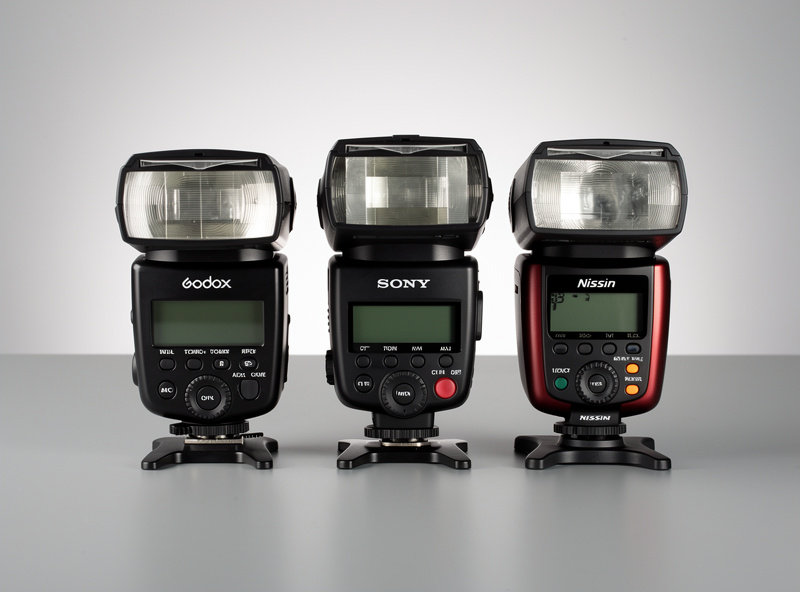
The Godox TT600 at $65 is the manual-only option for photographers who only need off-camera flash. It has the same guide number and radio receiver as the TT685II but no TTL metering — you set the power manually in 1/3-stop increments from 1/1 to 1/128. For off-camera use in a controlled setup, manual is actually faster than TTL because the power is consistent shot-to-shot, and the $65 savings funds a light stand and umbrella.
One feature worth understanding before buying is high-speed sync, which lets the flash fire at shutter speeds above the camera’s native sync speed — typically 1/200s or 1/250s. Without high-speed sync, shooting at 1/1000s produces a black band across the frame where the shutter curtain blocks part of the sensor during the flash burst. High-speed sync pulses the flash rapidly to illuminate the sensor as the shutter slit travels across it, which lets you shoot fill flash at any shutter speed — essential for outdoor portraits in bright sun with a wide aperture for shallow depth of field. All the speedlights in the table above support high-speed sync with their respective camera systems. The speedlight you buy first is the one that teaches you what you actually need from the second. Buy the cheapest unit that supports your camera’s wireless protocol — Godox TT600 manual at $65, or TT685II TTL at $130 — learn its quirks, and let the gap between what it does and what you wish it did dictate your next purchase. Most photographers end up with three speedlights of the same brand across two years because the radio ecosystem rewards staying in it. The wrong first purchase is paying $500 for a flagship before you know whether you actually need TTL, HSS, or a third group on the radio system.
Softboxes, umbrellas, and gels all mount to a speedlight the same way regardless of brand, using a standard hot-shoe-to-bracket adapter, which is worth knowing before you assume a modifier only works with one system. The modifier does more for the final image than the flash unit underneath it does — a $65 manual speedlight through a good softbox produces more flattering light than a $400 flagship fired bare, because the modifier is what controls shadow quality and the flash is just the power source behind it. Buying the flash first and the modifier as an afterthought is a common ordering mistake; the light quality improvement from a modifier is bigger than the improvement from any flash upgrade at the same price point.
Battery choice is the invisible cost factor in speedlight ownership. Four-AA alkalines deliver about 150 full-power pops before recycle times slow noticeably. Eneloop NiMH rechargeables push that to roughly 250 pops with faster recycle because they maintain voltage under load better than alkalines, and a set of four Panasonic Eneloop Pros costs $18 and lasts through hundreds of charge cycles. Lithium-ion speedlights like the Godox V860III and V1 eliminate AAs entirely — the included rechargeable pack delivers roughly 480 full-power pops on a single charge and recycles in 1.5 seconds even at the tail end of that runtime. The Li-ion premium is roughly $70 over the AA-powered TT685II, which buys roughly double the pops per charge and pays for itself in AA-battery savings within six months for anyone shooting events regularly.
The Godox TT685II at around $130 offers the best balance of price, power, and features. It includes TTL metering, built-in radio for off-camera use, and a guide number of 60. The system-specific version works natively with your camera brand for full TTL and high-speed sync compatibility.
TTL is easier for on-camera bounce flash where the subject distance changes constantly. Manual is better for off-camera flash in a controlled setup where flash-to-subject distance is fixed. I recommend a TTL-capable speedlight as a first purchase — you can switch it to manual for off-camera work.
Not for indoor bounce flash or close portraits. A GN of 36 to 42 handles most indoor situations. A GN of 50 to 60 is useful for outdoor fill flash against direct sun, large room bounce, or shooting through thick modifiers like softboxes that reduce effective output by 1 to 2 stops.
One speedlight for a single-light setup with a reflector for fill. Two speedlights for a key-light plus hair-light or background-light setup. Start with one, learn to use it off-camera with a modifier, and add a second only when you can articulate what creative problem the second light solves.
Yes, from reputable manufacturers like Godox, Nissin, and Yongnuo. The build quality is slightly below camera-brand equivalents, but the light output, radio functionality, and TTL accuracy are comparable. The price difference — $130 vs $400 — buys a second light and modifiers.

On-camera flash gets a bad reputation it only half deserves. Pointed straight ahead, the built-in…
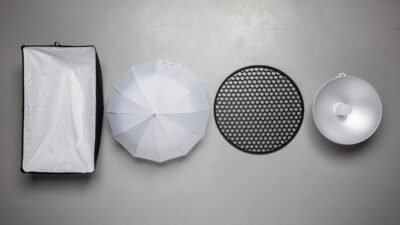
Light modifiers are tools placed between your flash and your subject that reshape light quality…

Why Off-Camera Flash Changes Everything Taking your flash off the camera gives you control over…
Leave a Reply