Variable ND vs. Fixed ND Filters: Which Should You Buy?
Buy a variable ND if you shoot video or run-and-gun in changing light and value…
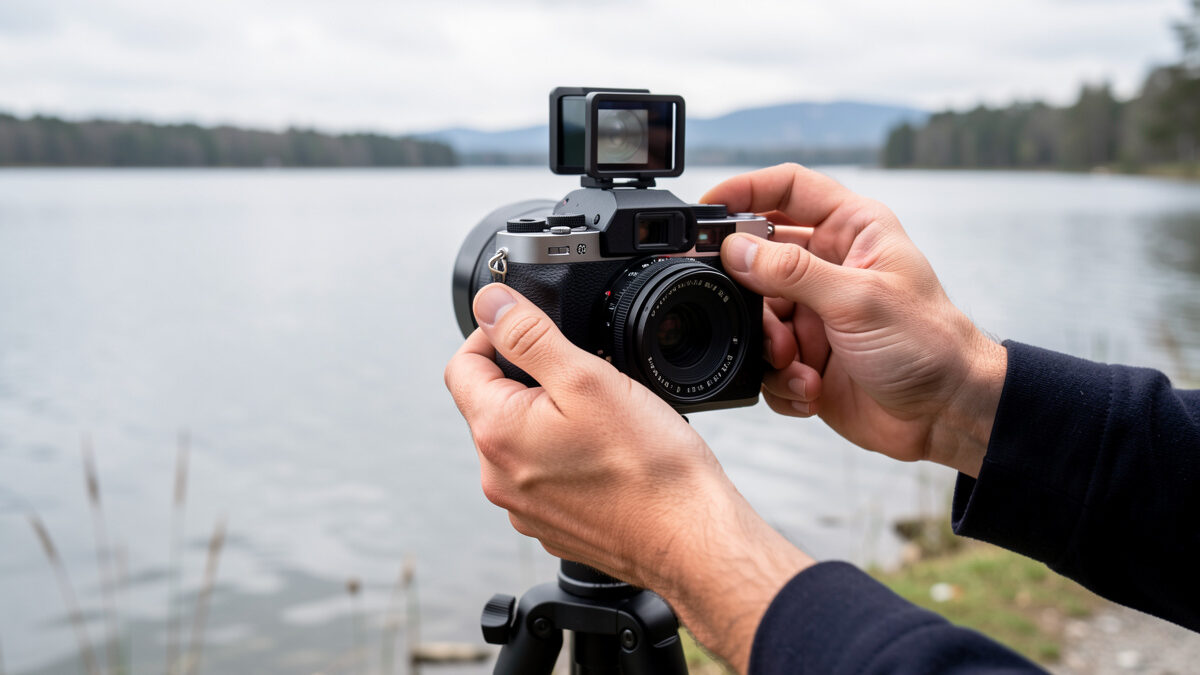
To calculate a long exposure time with an ND filter, meter the scene without the filter, then double your shutter speed once for every stop the filter blocks. A 10-stop ND means doubling ten times: a metered 1/60s becomes roughly 15 seconds. That doubling rule is the entire calculation, and once it’s in your fingers you’ll never be hostage to a wrong app reading again.
I run this math on a Fujifilm X-T5 at every coastline and stream, and I’ve learned to trust the count over the screen. The app on my phone once told me 4 minutes when the honest answer was 30 seconds — I’d left the base ISO on auto. Understanding why the number is what it is saved that frame. Let me hand you the same understanding, including the two places the neat doubling quietly breaks.
A neutral-density filter blocks a fixed number of stops of light without shifting color, so your camera needs a proportionally longer shutter to reach the same exposure. Each stop halves the light reaching the sensor, which means the shutter must stay open twice as long to compensate. That one-to-one relationship — one stop of ND, one doubling of time — is what makes the math tractable.
The confusion is entirely in the labeling. Manufacturers quote strength three ways: stops, an optical density number, and a filter factor. A 10-stop filter is also “ND1000,” also “3.0 density,” also “1000× factor.” They all describe the same glass. I think in stops because stops are what my camera speaks, and converting to stops first turns every filter into a simple count of doublings. Ignore the marketing number on the box and find the stop rating.
You count the stops of your filter, then step your shutter speed through that many doublings starting from your metered speed. Photographers memorize the standard full-stop shutter sequence, and each step down the ladder is one doubling. Here’s the ladder I count on, and the endpoint for the three filters I actually own.
| Metered speed | +6 stops (ND64) | +10 stops (ND1000) | +15 stops (ND32000) |
| 1/500 s | 1/8 s | 2 s | 1 min 4 s |
| 1/250 s | 1/4 s | 4 s | 2 min 8 s |
| 1/125 s | 1/2 s | 8 s | 4 min 20 s |
| 1/60 s | 1 s | 15 s | 8 min 30 s |
| 1/30 s | 2 s | 30 s | 17 min |
Read it as a shortcut, but understand the mechanism so you can do it without the table. Say I meter a bright overcast beach at 1/125s, f/11, ISO 125 and I’m mounting my 10-stop. I count ten doublings from 1/125: 1/60, 1/30, 1/15, 1/8, 1/4, 1/2, 1s, 2s, 4s, 8s. Ten steps lands on 8 seconds. That matches the table. The full-stop sequence isn’t perfectly mathematical — 1/125 is really 1/128, so the “8 seconds” is really about 8.2 — but your sensor can’t tell the difference and neither can the print.
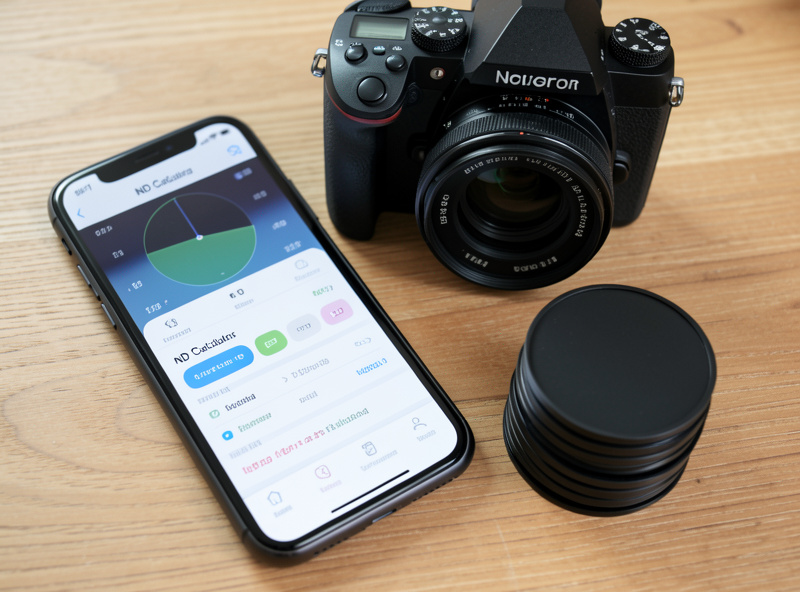
The clean doubling breaks in two places: fractional-stop filters and stacked filters. A filter sold as “ND1000” is nominally 10 stops, but real-world copies often measure 9.6 or 10.3 stops, and a variable ND has no fixed rating at all. When the number isn’t a whole stop, the doubling count no longer lands on a tidy shutter speed, and you have to interpolate or test.
Stacking is the second trap, and it’s additive, not multiplicative: a 6-stop plus a 3-stop is 9 stops total, not 18. I stack a 6 and a 3 fairly often to hit odd densities, and I just add the stop counts before I start doubling. The real hazard when stacking isn’t the math — it’s vignetting and color cast from two pieces of glass in the light path, which I cover separately. Verify a stacked calculation with a test frame; two mediocre filters compound their errors.
The third quiet gremlin is long-exposure reciprocity on very long frames. Digital sensors are far more linear than film, so for most daytime work you can ignore it, but past a minute or two some sensors need a small bump of extra time, and long-exposure noise reduction (LENR) will make the camera shoot a second dark frame of equal length — so a 4-minute exposure ties up the camera for 8 minutes. Plan for that when you’re calculating, or you’ll miss the light while the camera grinds.
Use an app for the arithmetic if you like, but understand the doubling first so you can catch the app when it’s wrong — and it will be wrong when your inputs are. A calculator is only as good as the base exposure you feed it, and the single most common error is a base ISO or aperture that drifted from what you think it is.
I keep the PhotoPills ND calculator on my phone for the minutes-long frames where counting fifteen doublings in my head is genuinely error-prone, and I’ve cross-checked it against my own results enough to trust it. But for anything up to 30 seconds I do it in my head, because the count is faster than unlocking the phone and it keeps me honest. The workflow is: meter and lock exposure in manual, note the shutter, then either count or type. Never let the app choose your aperture or ISO — those are creative decisions, and the calculator only handles the last, mechanical step.
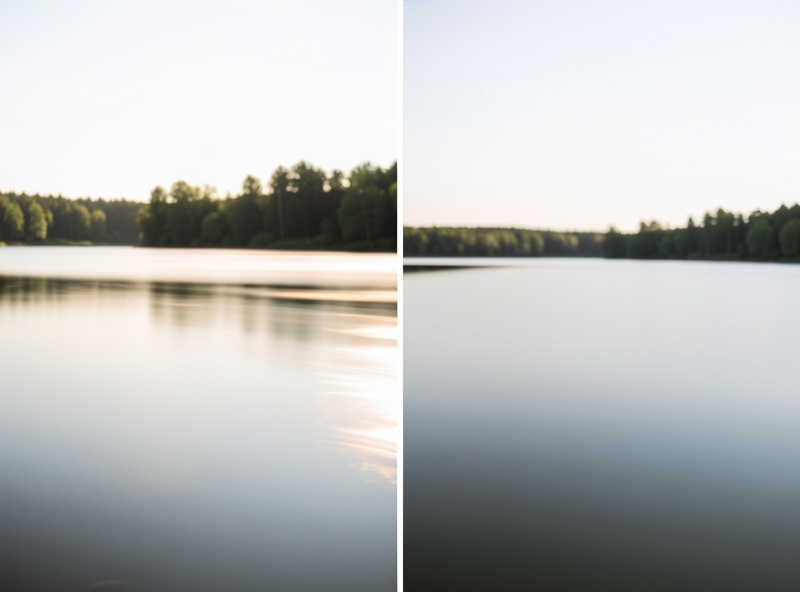
Shoot your first frame at the calculated time, then read the histogram — not the pretty rear-screen thumbnail — and adjust in whole stops. If the histogram is crowding the right edge and the highlight blinkies are firing, halve the time; if it’s bunched left, double it. One test frame confirms or corrects the entire calculation in ten seconds.
I expose to the right (ETTR) deliberately to protect shadow detail, so my “correct” histogram sits further right than a beginner’s instinct. The point is that the calculation gets you within a stop, and the histogram closes the gap. I’ve stopped trusting the rear-screen image entirely for exposure — on a bright day it looks blown when it’s fine, and looks fine when it’s clipped. The histogram doesn’t lie, and at multi-second exposures you have all the time in the world to read it before the next frame. This whole calculate-then-verify loop is the backbone of every technique in the daytime long exposure guide — the ND math is just the first gate.
The mistakes cluster in four spots: metering with the wrong base settings, forgetting the camera’s 30-second ceiling, mixing up filter-factor and stop numbers, and ignoring the dark-frame delay. Each one is quick to diagnose once you know to look, and each has personally cost me frames until it became reflex.
The base-settings error is the big one. Your calculation inherits whatever aperture and ISO you metered at, so if you meter wide open at f/2.8 and then stop down to f/11 to shoot, your calculated time is five stops too short and the frame comes out nearly black. Meter at your shooting aperture and ISO, full stop. The second trap is the 30-second wall: almost every camera’s timed shutter maxes at 30 seconds, so any calculated time beyond that has to run in bulb mode with an external timer holding the shutter — if you forget, the camera silently caps at 30 seconds and underexposes. The third is reading “ND1000” as ten and “ND64” as sixty-four in the same breath; they’re different scales, so always convert to stops before you count.
The fourth is planning. If I’m shooting a four-minute frame with long-exposure noise reduction on, the camera is busy for eight minutes total, and in changing coastal light that can mean the wave set or the cloud gap I wanted is gone before the sensor is free. I decide up front whether the hot-pixel cleanup is worth the doubled wait, and on shorter frames I often turn LENR off and heal the few hot pixels in Lightroom instead. Knowing where the time actually goes is as much a part of the calculation as the doubling itself.
Last autumn on a granite headland I metered the incoming sea at 1/250s, f/13, ISO 125 under thin cloud, and I wanted roughly 25 to 30 seconds to pull the waves into mist. From 1/250, a 10-stop lands at 4 seconds — too short. So I stacked my 10-stop and my 3-stop for 13 stops total: from 1/250, that’s 4 seconds (the 10) doubled three more times — 8, 16, 32 seconds. Thirty-two seconds, near enough to my target. First frame confirmed the histogram, the second nailed it, and the rocks came out as islands in flat silk. The math took longer to explain than to do.
That’s the whole discipline: decide the duration you want from the subject, pick or stack the ND that delivers it, count the doublings from your metered speed, and let the histogram fine-tune. Do it a dozen times and the arithmetic disappears into instinct — you’ll glance at the light, glance at your filter, and know the number before the camera does.
Meter the scene without the filter, then double your shutter time ten times, once per stop. For example a metered speed of 1/60 second doubled ten times is about 15 seconds. Set bulb mode for anything longer than your camera’s 30-second limit and confirm with the histogram on the first frame.
You add the stop counts. A 6-stop filter plus a 3-stop filter blocks 9 stops total, not 18. Add the stops first, then double your shutter speed that many times. Watch for extra vignetting and color cast when stacking two filters, and verify the result with a test frame.
Almost always because the base exposure you entered is off. If your ISO or aperture drifted from what you assumed, the calculated time will be wrong even though the filter math is right. Lock exposure in manual, note the exact metered shutter speed, and feed the app the real numbers.
Far less than film. Digital sensors stay close to linear, so for daytime exposures up to a minute or two you can usually ignore reciprocity. On very long frames some sensors need a small extra bump, and long-exposure noise reduction will double the total time by shooting a matching dark frame.
They are the filter-factor names for 3-stop, 6-stop, and 10-stop filters respectively. ND8 blocks 3 stops, ND64 blocks 6 stops, and ND1000 blocks 10 stops. Convert whatever number is on the box to stops first, because stops are what your camera and the doubling rule use.
For the underlying exposure theory, the PhotoPills ND guides and the Lee Filters technical pages are the references I check when I want to confirm a spec rather than trust memory.
Buy a variable ND if you shoot video or run-and-gun in changing light and value…
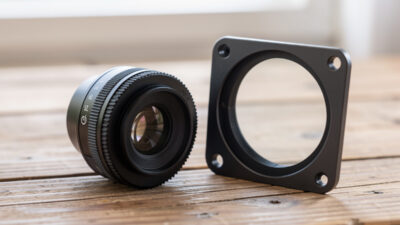
Screw-in filters win for most photographers: they are compact, sealed, cheaper to start, and perfect…
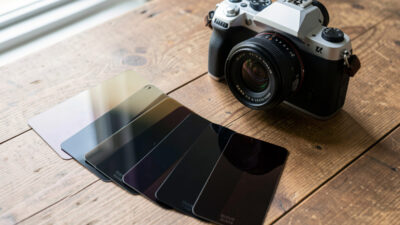
For most photographers the honest answer is three ND filters: a 3-stop for wide-aperture work…
Leave a Reply