The Reciprocal Rule and Beyond: Minimum Shutter Speed for Sharp Shots
The reciprocal rule says your shutter should be at least one over your equivalent focal…
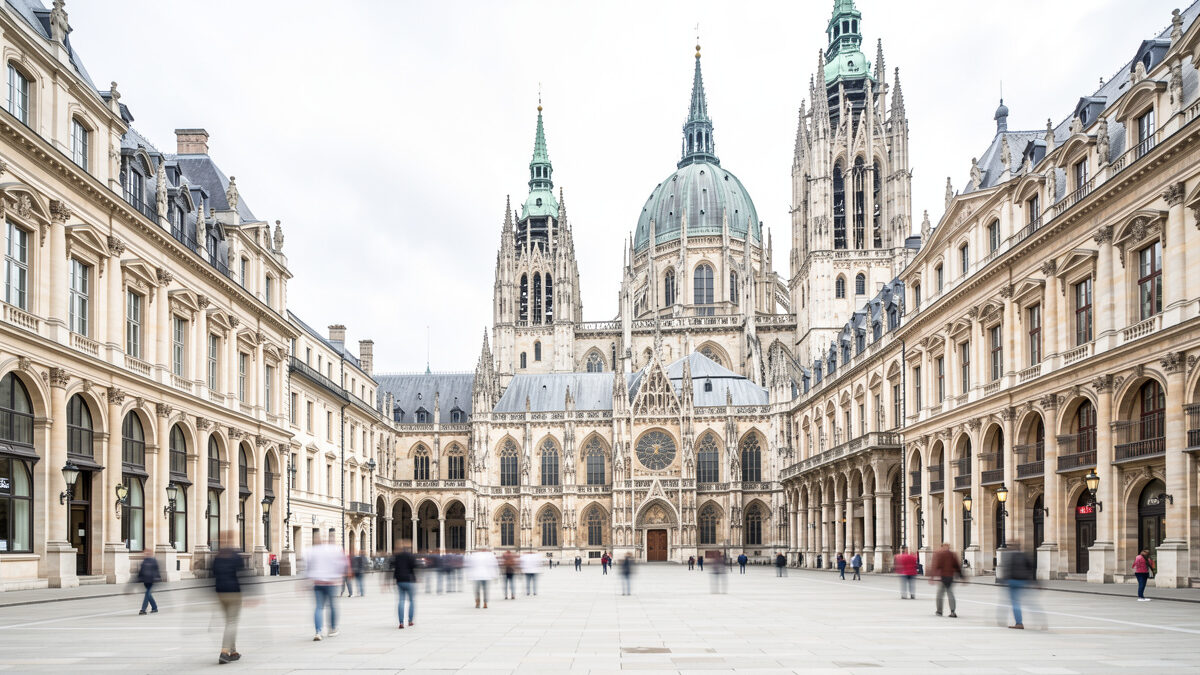
To remove people from a scene with a long exposure, use a strong ND filter to stretch the shutter to 30 seconds or several minutes, so anyone who keeps walking through the frame blurs into invisibility while the static architecture stays sharp. Moving people simply don’t stay in one spot long enough to register. The catch is anyone who stops — a person who pauses becomes a ghost, and a person who sits becomes a subject.
I’ve cleared tourists off cathedral steps and market squares this way across a few European trips with my Fujifilm X-T5, and it’s the most satisfying party trick in the long-exposure toolkit: you watch a heaving plaza on the ground glass turn into an eerily empty stage. But it’s less automatic than it looks. How long it takes depends on how the crowd moves, and there are a couple of tricks for the stubborn stragglers. Here’s the method that actually works.
A long exposure records the average of everything that happened during the shutter’s open time, and a moving person occupies each spot for only a fraction of that time, so they contribute too little brightness to any one pixel to show up. The stationary building behind them, present for the entire exposure, records at full strength and stays sharp. The person is effectively erased by their own motion.
The key word is average. If someone walks steadily across a 60-second frame, they might spend half a second in any given spot — less than one percent of the exposure — so they blur to nothing. But if they stand still for 20 of those 60 seconds, that’s a third of the exposure, and they show up as a translucent ghost. The math is simply the fraction of the exposure a person spends in one place. This is why a busy-but-flowing crowd vanishes easily while a scattering of people sitting on steps is much harder to remove. Motion is what does the erasing, so the more people move, the cleaner your empty scene.
Plan on 30 seconds to two minutes, with the exact time driven by how fast and how densely people move through the frame. A steady flow of pedestrians on a busy street clears in about 30 to 60 seconds. A crowded plaza where people linger, photograph, and stop needs two minutes or more, and even then a few stubborn statues may need help. Faster movement and longer exposures both clean the frame better.
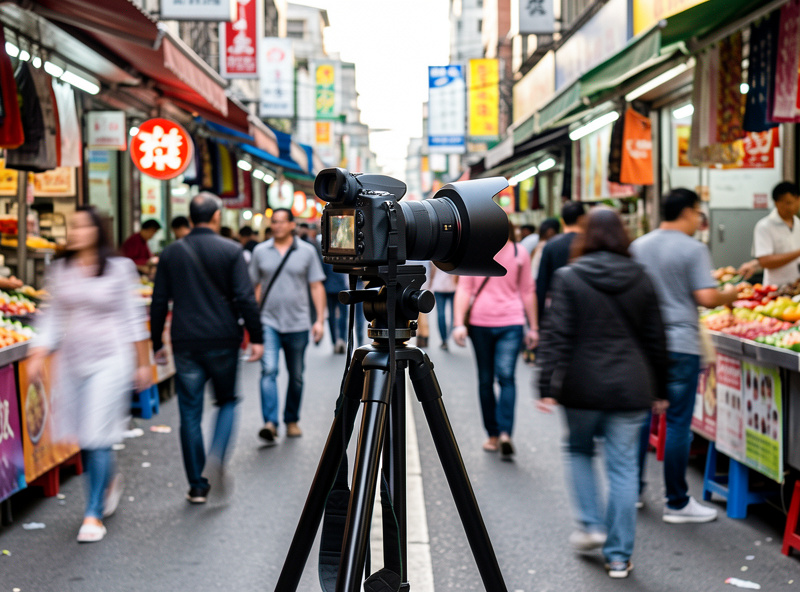
Getting to those durations in daylight means a strong ND. A 10-stop gets me to 30 to 60 seconds in most daytime light, which handles flowing streets. For the two-minute-plus frames a busy tourist square demands, I stack a 10-stop and a 3-stop for 13 stops, or use a 15-stop in bright sun. The exposure is the same doubling calculation as any long exposure — meter, count the stops, double the time — worked exactly as in the ND calculation guide. One practical note: if you’re near the limit of clearing a crowd, a longer exposure almost always helps, so err long. A four-minute frame erases nearly everyone who isn’t rooted to the spot.
There’s a stacking trick for extreme crowds that I fall back on when even four minutes won’t clear a packed square: shoot a burst of shorter frames and median-stack them in software. Each pixel takes the median value across the stack, and since people are in different places in each frame, the median resolves to the empty background. It’s a post-processing technique rather than a single long exposure, but it clears crowds that no single frame can, and it doesn’t need an ND at all. I keep it in my back pocket for the busiest sites.
People who stop moving are the whole problem, and the fix is patience plus timing: watch the scene, and trigger your exposure during a lull or when the stationary people happen to shift. Anyone who sits on a bench for your entire two-minute frame will appear as a solid subject; anyone who pauses for 20 seconds appears as a translucent ghost. You’re managing the odds, not guaranteeing an empty frame.
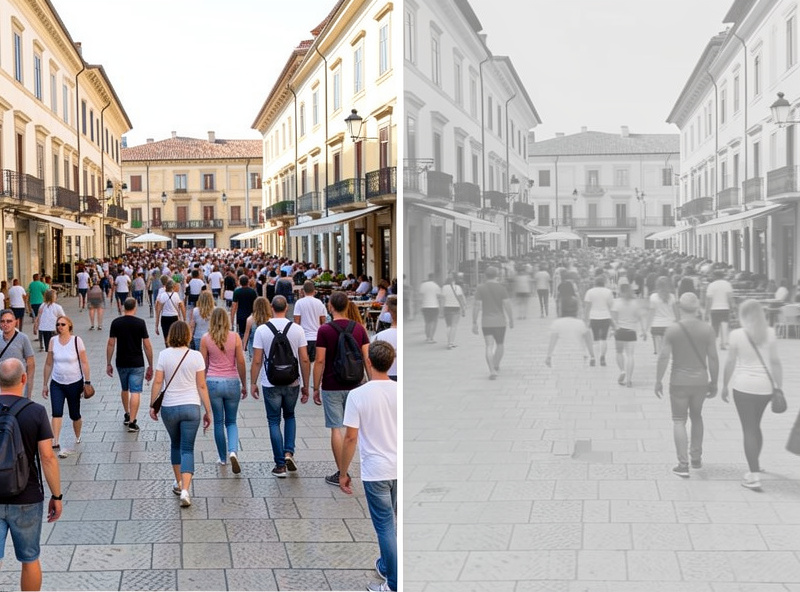
My approach is to shoot several frames and watch the crowd’s rhythm. Tourist sites have lulls — a tour group moves off, a light changes, the crowd thins for a minute — and I fire then. I also shoot multiple long frames from the exact same locked-down composition, because a person sitting still in frame one may have wandered off by frame three, and I can either pick the cleanest single frame or blend the empty parts of several in Lightroom. The tripod staying rooted between frames is what makes that blending possible, so I never touch the composition once I start. On the steps of a cathedral last spring it took me four two-minute frames before a group finally moved and I got a clean plaza. Patience is the actual skill here; the camera part is easy.
It works best on grand static architecture that’s normally swarmed — cathedral squares, monument steps, famous bridges, museum halls, and shopping arcades — anywhere the building is the star and the crowd is the problem. The more impressive and permanent the backdrop, the more dramatic the empty version feels, because your brain knows the place is never actually deserted.
The technique struggles in a few predictable places. Anywhere people naturally stop — viewpoints, benches, café terraces, queue lines — leaves you fighting ghosts, and dense slow-shuffling crowds that never really flow can defeat even a four-minute frame. It also needs enough contrast between the moving people and the background; a crowd in bright clothing against a dark interior can leave faint streaks that a same-toned crowd wouldn’t. My best results have come from wide plazas at the shoulders of the day — early morning before the tour buses, or the blue-hour window when the crowd thins and the low light lets me run long frames with a lighter filter. A deserted-looking Venetian square at dawn, shot at 90 seconds, remains one of my favorite frames precisely because anyone who’s been there knows it’s impossible. That impossibility is the whole appeal, and it’s why the technique rewards scouting the site’s rhythm before you commit.
You need a rigid tripod, a strong ND filter, a remote release for the multi-minute frames, and base-ISO manual settings dialed for maximum sharpness on the static scene. Since your subject is unmoving architecture, you want everything tack sharp, which means base ISO, a mid aperture around f/8 to f/11, and a rock-solid platform. The moving people are the only thing you want blurred.
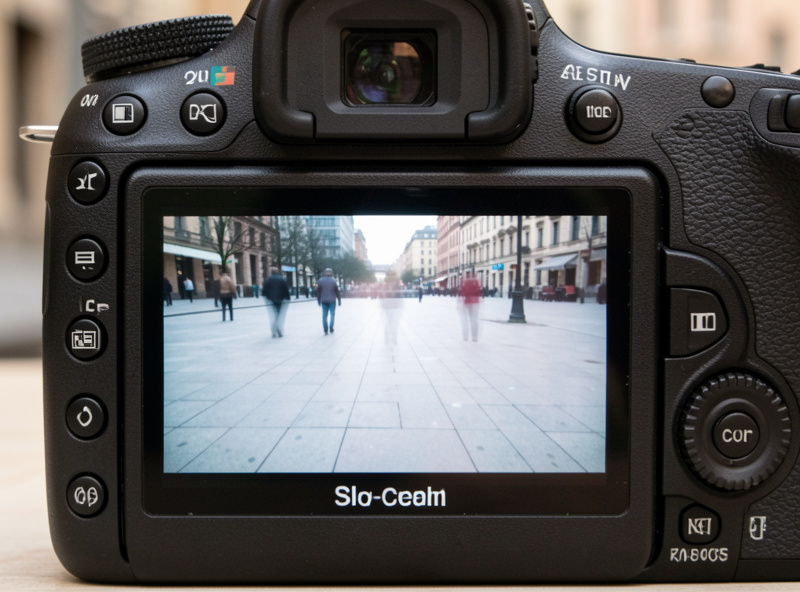
I shoot these at ISO 125, f/8 or f/11, on the XF 16-55mm f/2.8, focused a third into the scene and locked to manual so nothing hunts through the dark filter. A remote release or intervalometer holds the bulb shutter for the two-to-four-minute frames — there’s no shooting these handheld or on a self-timer alone — and I cover the eyepiece to stop light leaking in over such long frames. If your architecture comes out soft rather than the people, the platform is the problem, and the fixes are in why your long exposures are soft; for choosing a release that can time multi-minute bulb frames, see the best remote shutter releases and intervalometers. This all sits inside the broader daytime toolkit in the daytime long exposure guide.
One etiquette and safety note from experience: a tripod with a huge filter in a busy public square draws attention and can block foot traffic, so I set up at the edge, stay aware of my surroundings, and check whether tripods are even allowed — some cathedrals and monuments ban them. Getting moved along by a guard mid-exposure ruins the frame and the mood. A quick check beforehand saves the session.
Usually 30 seconds to two minutes. A steady flow of pedestrians clears in 30 to 60 seconds, while a crowded plaza where people linger needs two minutes or more. Faster movement and longer exposures both clean the frame better, so when in doubt use a longer time.
Because they stopped moving. A long exposure erases people by their motion, so anyone who stands or sits still for a large fraction of the exposure records as a ghost or a solid subject. Watch the scene and trigger during a lull, or blend the empty parts of several frames shot from a locked tripod.
A 10-stop ND gets you to 30 to 60 seconds in daylight, which clears flowing streets. For busy tourist squares that need two minutes or more, stack a 10-stop with a 3-stop for 13 stops, or use a 15-stop in bright sun. Calculate the shutter with the doubling rule.
Yes, with median stacking. Shoot a burst of frames from a locked tripod, then median-stack them in software so each pixel takes the middle value. Because people are in different places in each frame, the median resolves to the empty background. It clears crowds that no single exposure can and needs no ND filter.
Base ISO, an aperture around f/8 to f/11 for sharp architecture, manual focus locked before the filter goes on, and a shutter of 30 seconds to several minutes set with a remote release. The static scene must be tack sharp while the moving people blur away, so prioritize a rigid tripod and low ISO.
The median-stacking approach is well documented in the Adobe Photoshop statistics/stack-mode documentation, and for planning the light and crowd-thin hours at a specific site I use the sun-position tools in PhotoPills.

The reciprocal rule says your shutter should be at least one over your equivalent focal…

You can gain one to two stops of handholdability without spending a krona, just by…
Output sharpening should match where the image is going — a web export at 2048…
Leave a Reply