How to Shoot Silky Water: Waterfalls and Seascapes
To shoot silky water, put the camera on a rigid tripod, add an ND filter…
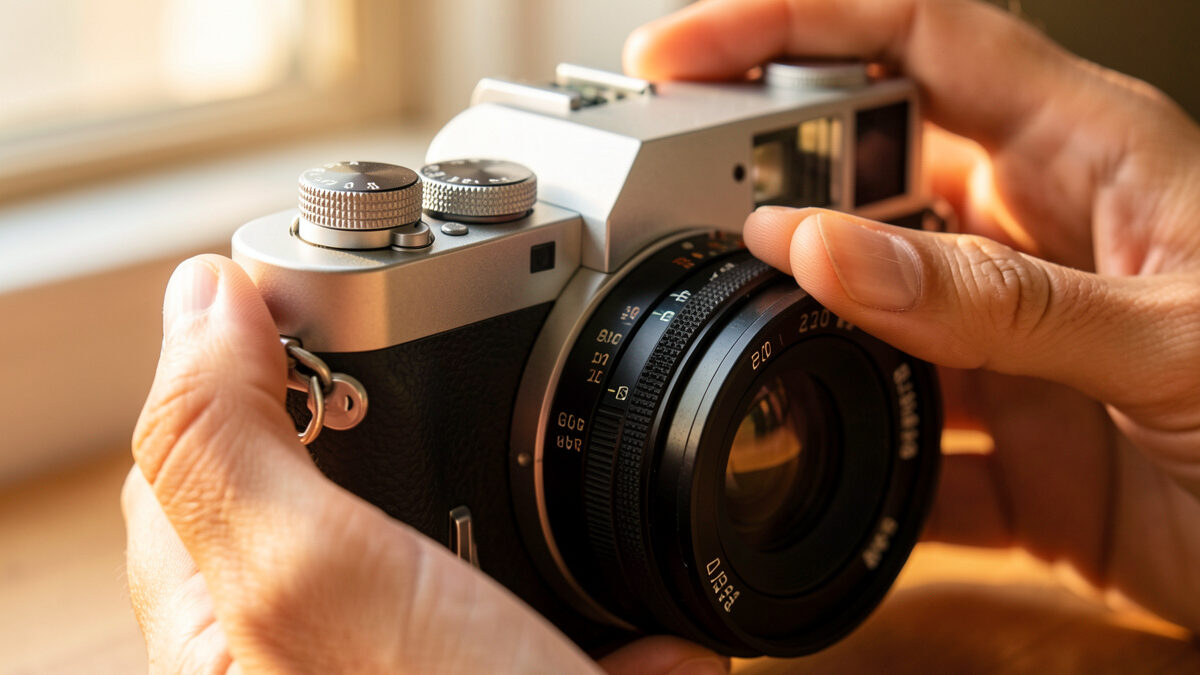
The reciprocal rule says your shutter should be at least one over your equivalent focal length — a 50mm lens wants 1/50s, a 200mm wants 1/200s. On a modern high-resolution sensor that floor runs a stop too optimistic. Treat it as the minimum, not the target, or soft frames keep surprising you.
I’ve shot this rule against a test wall on both my bodies, and the verdict is blunt: the reciprocal rule was written for 12-megapixel film and DSLRs, and my 40MP Fujifilm X-T5 resolves the exact hand tremor that older, lower-resolution sensors quietly blurred away and forgave. So I double it. Here’s the reasoning, the crop-factor trap that catches APS-C shooters, and the two separate shutter budgets you have to satisfy at once. It’s one lever in the full sharpness chain I map in how to get sharp photos every time.
The rule links shutter speed to focal length because longer lenses magnify shake. A tiny angular tremor in your hands moves the projected image a little at 24mm and a lot at 300mm — the longer the lens, the more the same wobble smears across the sensor. So the minimum safe shutter scales with focal length: 1/focal-length, in seconds. At 35mm you need 1/35s (round to 1/40s); at 85mm, 1/85s (round to 1/100s); at 300mm, 1/300s (round to 1/320s). Round up to the nearest available speed, never down.
It’s a genuinely good starting point, grounded in real optics, and the exposure fundamentals behind it are laid out well at Cambridge in Colour. But “starting point” is the operative phrase. The rule assumes average hands, a static subject, and — critically — a sensor forgiving enough that sub-pixel shake doesn’t show. Two of those three assumptions have quietly expired.

Resolution is the reason. When a sensor packs more, smaller photosites into the same area, each one resolves finer detail — including finer motion. A degree of hand tremor that spread across, say, half a pixel on a 12MP sensor might spread across a pixel and a half on my 40MP X-T5, and that’s the difference between “critically sharp” and “slightly soft” at 100%. The lens didn’t change and my hands didn’t change; the ruler got finer.
This is why I run the reciprocal as a hard minimum and then double it for anything I care about. My XF 56mm f/1.2 frames like an 85mm and reads as “1/85s” by the rule; I shoot it at 1/160s handheld, minimum. It’s also why buying a higher-resolution body is a stricter homework assignment, not a free sharpness win — a point I make in detail in the sharpness hub. The flip side: if you only ever view your images at web size, the old rule is fine, because the softening never survives the downscale. It’s the 100% crop and the big print where the doubled rule earns its keep.
This is the trap that catches APS-C shooters. The reciprocal rule is written for the equivalent focal length, not the number printed on the barrel. My XF 55mm on the X-T5’s APS-C sensor frames like an 82mm lens, because the 1.5x crop factor multiplies the effective reach. So the rule wants 1/82s (call it 1/100s), not the 1/55s the barrel marking would suggest. Ignore crop factor and you’ll set your shutter a full third too slow on every crop-body lens.
The logic is that shake shows up relative to the framing, and the crop sensor is framing tighter — magnifying both the subject and your tremor. Micro Four Thirds shooters double the barrel number (2x crop); APS-C shooters multiply by 1.5 (or 1.6 on Canon). Then, if you’re on a dense sensor, double that for the resolution penalty. It sounds fussy written out, but in practice it collapses to a habit: I glance at the equivalent focal length in the viewfinder and set the shutter to twice its reciprocal. The whole APS-C-versus-full-frame framing question, including how it changes your working numbers, is in full frame vs APS-C.

In-body stabilization buys back shutter latitude for camera shake — and only for camera shake. A body rated for several stops of correction can, in theory, let you shoot several stops below the reciprocal floor and still hold a static subject sharp. In practice I discount the rating heavily and treat the reciprocal-doubled number as my default, dropping below it only when I’ve confirmed the stabilizer is earning its stops on that particular scene.
The crucial caveat is that stabilization does nothing for a moving subject, so it only relaxes half of your shutter obligation. I break down exactly where it helps and where it’s useless in image stabilization explained: when IBIS helps and when it can’t — read it alongside this, because the reciprocal rule and stabilization are two dials on the same problem. Shooting handheld after dark is where I juggle both hardest, and that workflow lives in my night photography settings for travel.
Here’s the part the reciprocal rule ignores entirely: it only addresses camera shake. Subject motion is a completely separate shutter budget, and your final shutter speed has to clear the higher of the two. The reciprocal might say 1/100s is fine for camera shake at 85mm — but if your subject is a kid on a scooter, 1/100s will smear them into abstraction no matter how still your hands are.
So I run two numbers in my head and take the faster. A seated portrait sitter needs maybe 1/160s to freeze the small sways and blinks; a person walking, 1/250s; a dog trotting, 1/500s; a cyclist or a running child, 1/1000s; a bird in flight, 1/2000s and up. This is where the reciprocal rule and action photography meet, and the full action-settings breakdown is in my sports photography settings and wildlife camera settings guides.
Rules of thumb are only useful once they become numbers you don’t have to think about. This is the working table I’ve settled on across both systems — the left column is the camera-shake floor from the doubled reciprocal, the right is the subject-freeze floor. Take whichever is faster.
| Scenario | Focal length (equiv.) | Camera-shake floor | Subject-freeze floor |
|---|---|---|---|
| Static landscape, braced | 24mm | 1/50s | n/a (static) |
| Environmental portrait | 35mm | 1/80s | 1/160s (small sways) |
| Head-and-shoulders portrait | 85mm | 1/160s | 1/200s |
| Street candid, walking subject | 50mm | 1/100s | 1/250s |
| Kids or pets at play | 85mm | 1/160s | 1/500s |
| Telephoto wildlife, perched | 300mm | 1/640s | 1/1000s |
| Birds in flight | 450mm | 1/900s | 1/2500s |
Notice how often the subject-freeze number is the binding one. That’s the lesson: for anything alive, the reciprocal rule is almost never your real limit.

Yes — and pretending otherwise is how people end up over-correcting. Every stop of shutter speed you add has to be paid for somewhere in the exposure triangle: you either open the aperture (shallower depth of field, and eventually past the lens’s sharp aperture) or raise ISO (more noise). There is no free shutter speed. The art is spending only what the shot actually needs, not blindly cranking to 1/2000s because faster feels safer.
My habit is to set the shutter to the slower of my two floors that still freezes the scene, then let auto-ISO absorb the rest. For a static landscape I’ll happily sit at 1/50s and keep ISO at base, because there’s nothing to freeze and base ISO gives me the cleanest file for a big print. For a portrait I’ll accept ISO 1600 to hold 1/200s, because a hint of grain is invisible and a soft eye is fatal. On my X-T5 I’ll push to ISO 6400 without flinching when the alternative is a blurred frame — modern sensors and Lightroom’s noise reduction make that trade a bargain. The mistake is treating noise as the enemy; motion blur is the unrecoverable one. You can denoise a grainy sharp frame. You cannot un-blur a soft one.
The best way to enforce all of this is to let the camera do it. Both my bodies — and most modern mirrorless, per the Fujifilm X menu system — let you set a minimum shutter speed in auto-ISO. You pick the slowest shutter the camera is allowed to use in aperture-priority; below that, instead of dropping the shutter and handing you a blurry frame, it raises ISO. A slightly noisier sharp frame beats a clean smear every single time.
I set mine to my doubled-reciprocal number per lens, and on bodies that offer it I use the “Auto” minimum-shutter mode that scales the floor with focal length as I zoom. It’s the closest thing to a set-and-forget sharpness insurance policy. My own early mistake was the opposite — I shot aperture-priority with no floor for a year and never understood why my indoor family frames were soft, until I realized the camera had been quietly picking 1/30s all evening. One menu setting fixed a whole category of ruined shots. If you take one thing from this article, make it that floor.
The reciprocal rule sets your minimum handheld shutter speed to one over your full-frame-equivalent focal length. A 50mm lens needs at least 1/50 second, a 200mm needs 1/200 second. It exists because longer lenses magnify hand shake, so the safe shutter speed scales with focal length.
Not quite. It was calibrated for lower-resolution film and DSLR sensors. High-resolution sensors resolve finer hand tremor, so the rule runs about a stop optimistic. Doubling it, using two over the equivalent focal length, is a safer floor for critical sharpness at 100 percent or in large prints.
The equivalent. On an APS-C body multiply the barrel focal length by about 1.5 first. A 55mm lens on APS-C frames like 82mm and needs roughly 1/100 second, not 1/55. Ignoring crop factor sets your shutter too slow on every crop-body lens.
No. It only addresses camera shake. Subject motion is a separate budget, and your shutter must clear whichever is faster. A walking person needs about 1/250 second and a running child around 1/1000 second regardless of how steady your hands are.

To shoot silky water, put the camera on a rigid tripod, add an ND filter…

Focus stacking merges several frames focused at different distances into one image where every plane…

To remove people from a scene with a long exposure, use a strong ND filter…
Leave a Reply