In-Camera Focus Bracketing: Setup and When to Trust It
In-camera focus bracketing is the feature, built into bodies like my Fujifilm X-T5 and Sony…

Image stabilization fights camera shake only — nothing else. IBIS floats the sensor to cancel hand tremor, buying most shooters three to five usable stops of slower shutter. What it can never do is freeze a moving subject. Know that boundary and you’ll always know when to trust it.
I run IBIS every day on my Fujifilm X-T5, and I’ve handheld sharp half-second frames in a Swedish church interior with nothing but the stabilizer and good bracing. I’ve also come home with a folder of useless mush because I trusted IBIS to do a job it physically cannot do. That gap — between what the marketing implies and what the physics allows — is the whole point of this article. It’s one lever in the larger sharpness chain I map out in how to get sharp photos every time.
Stabilization measures the camera’s own tiny movements — pitch, yaw, and on modern bodies roll and two shift axes too — and physically counter-moves the sensor (IBIS) or a lens element (optical stabilization) to keep the projected image still on the sensor during the exposure. Gyroscopes detect the shake at high frequency; actuators shove the sensor the opposite way in real time. The result is that a frame which would have smeared from your pulse and micro-tremors instead stays crisp.
The key word is camera. The system knows how the body is moving because it can feel itself move. It has no idea how the world is moving. So it can perfectly cancel the wobble in your hands and do absolutely nothing about the child running across your frame. On my X-T5 the five-axis unit is genuinely excellent for static scenes — I’ve printed sharp interiors shot at 1/8s handheld that I’d never have attempted on my old DSLR. The sensation is subtle but real: with IBIS engaged, the viewfinder image visibly settles, like the scene stopped breathing. That settling is your cue that the stabilizer has locked, and I wait for it before I squeeze.
Manufacturers quote stabilization in “stops” — a body rated for seven stops claims you can shoot seven stops slower than the unstabilized floor and still be sharp. Those numbers come from a standardized shake-table test defined by the Camera & Imaging Products Association (CIPA), which oscillates the camera at set frequencies and amplitudes and measures the resulting blur. It’s a fair, repeatable lab test. It is not your hands on a cold morning after two coffees.
In the field I discount the rating by two to three stops and treat what’s left as the honest number. My X-T5 carries a headline rating in the seven-stop range; in real use I plan around four solid stops and treat anything beyond that as a bonus I re-shoot to confirm. That’s not a criticism of Fujifilm — it’s how every rating works, because the CIPA rig doesn’t have a heartbeat, doesn’t sway, and doesn’t press the shutter with a human finger. Longer focal lengths also eat into the benefit: stabilization corrects angular shake, and the longer the lens, the more a tiny angle translates into blur at the sensor, so my XF 70-300mm gets less practical help than my XF 23mm. Rate it low, and you’ll be pleasantly surprised instead of betrayed.
Stabilization earns its keep whenever the subject is still and the light is low: interiors, architecture, still life, landscapes at blue hour, product shots, copy work. Anywhere you’d reach for a tripod but can’t or won’t carry one, IBIS is the next best thing. It’s also a gift for deliberate slow-shutter effects handheld — silky water, light trails, motion in a crowd around a static anchor — where you actually want the moving elements to blur while the fixed ones stay razor sharp.
Handheld night work is where I lean on it hardest. Shooting a lamplit street at 1/10s, IBIS holds the buildings and signs sharp while the passing cyclist streaks — exactly the look I want. That whole workflow, including how I balance ISO against shutter after dark, is in my night photography settings for travel. For the deeper theory on why a slower shutter risks blur in the first place — the shutter-shake math IBIS is buying you room against — the sharpness hub lays out the full chain.
Three situations. First and most important: moving subjects. A running dog, a cyclist, a kid on a swing — at a slow shutter these blur no matter how many stops your body is rated for, because the stabilizer cancels your motion, not theirs. This is the single most common IBIS misconception I see, and it’s why “my new stabilized camera still blurs my kids” is a question I get constantly. The fix isn’t more stabilization; it’s a faster shutter, the same one you’d use for sports and action.
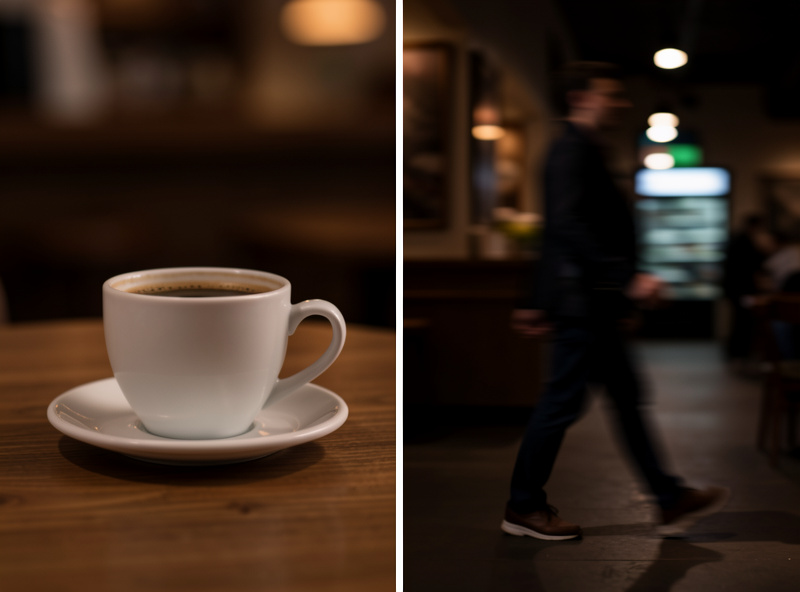
Second: very fast shutter speeds. Above roughly 1/500s the exposure is already too brief for hand tremor to register, so stabilization does nothing useful — it’s just running in the background. No harm, no benefit. Third, and this one bites people: on a tripod, some stabilization systems hunt for motion that isn’t there and introduce a faint wobble, softening a frame that should be perfectly locked. My rule is simple and I’ll expand on it below — tripod means IBIS off.
Three technologies wear the same “stabilization” badge and they are not equal. IBIS moves the sensor and works with any lens you mount, including adapted vintage glass with no electronics — a huge win if, like me, you shoot a manual M42 Helios on a modern body. Optical stabilization (OIS, VR, IS, OSS depending on the brand) moves a group inside the lens; it can be tuned for that specific focal length and is often slightly more effective on long telephotos, but it only exists on lenses that build it in.
On my systems the two cooperate: a stabilized lens on a stabilized body can share the correction across axes for a bit more total benefit. Digital or “electronic” stabilization is the odd one out — it crops into the frame and shifts the readout to smooth motion, which costs resolution and is really a video tool. For stills, it’s not something I use. The practical takeaway: IBIS is the versatile generalist, OIS is the specialist that shines on reach, and digital is for video. Match the tool to the job and don’t assume a spec-sheet “stabilized” tells you which one you’re getting.
Yes, as a default. On a locked-down tripod there’s no hand shake left to correct, and a stabilizer still searching for motion can add a low-frequency drift that softens long exposures — the exact opposite of what you want. I turn IBIS off the moment the camera goes on my carbon travel tripod, along with using a two-second timer or remote so my finger never touches the body during the exposure. For the tripods I actually trust to hold my kit dead still, see my tripod buying guide.
There’s a caveat worth knowing: a few recent bodies detect a tripod and disable stabilization automatically, or have a dedicated tripod mode. If yours does, let it. But if you’re unsure, off is the safe assumption. I learned this the annoying way — a set of long-exposure blue-hour frames from a harbor came back mysteriously soft despite a rock-solid tripod, and the only variable was IBIS left on. Every frame after I switched it off was tack-sharp. One setting, a whole evening’s difference.
For long handheld sessions far from power, stabilization changes your kit math. Because IBIS lets you keep the shutter slower and the ISO lower, you can lean on ambient light instead of hauling a tripod or flash — lighter bag, faster shooting. The trade-off is battery: driving the sensor actuators continuously sips power, and mirrorless bodies are already thirsty. On multi-day trips I plan power around that draw, which is why I carry the field-power setup I break down in field photography power: camera battery vs power bank vs LiFePO4. The Fujifilm X system documentation is worth a read for how each body handles the stabilizer’s power states, because leaving it fully active when you don’t need it is a quiet battery tax.
Sensor format plays in too. The physics of stabilization is the same across formats, but framing and shutter needs differ, which ties back to the broader full-frame vs APS-C trade-offs. Stabilization doesn’t change which format is “sharper” — it just changes how slow you can go before your hands become the limit.
IBIS stabilizes camera shake only. It floats the sensor and counter-moves it to cancel your hand tremor and body sway, which lets you shoot at slower shutter speeds and still get a sharp frame. It has no way to detect or correct subject motion.
No. Stabilization counters the camera’s motion, not the subject’s. A running dog or a walking person will blur at a slow shutter no matter how many stops of stabilization your camera is rated for. To freeze a moving subject you need a faster shutter speed.
Discount the manufacturer’s rating by two to three stops for real-world use. The quoted number comes from a CIPA shake-table test with no human tremor or sway involved. A body rated for seven stops typically delivers about four usable stops in the field, and less at long focal lengths.
As a default, yes. On a locked tripod there is no hand shake to correct, and some systems hunt for motion that is not there and add a faint drift that softens long exposures. Some recent bodies detect a tripod and disable it automatically; if unsure, switch it off.

In-camera focus bracketing is the feature, built into bodies like my Fujifilm X-T5 and Sony…
Focus stacking merges several frames focused at different distances into one image where every plane…
Output sharpening should match where the image is going — a web export at 2048…
Leave a Reply