Prime vs Zoom Lenses: When to Use Each and Why It Matters
I’ve chart-tested both primes and zooms across my two mounts — Fuji X on the…
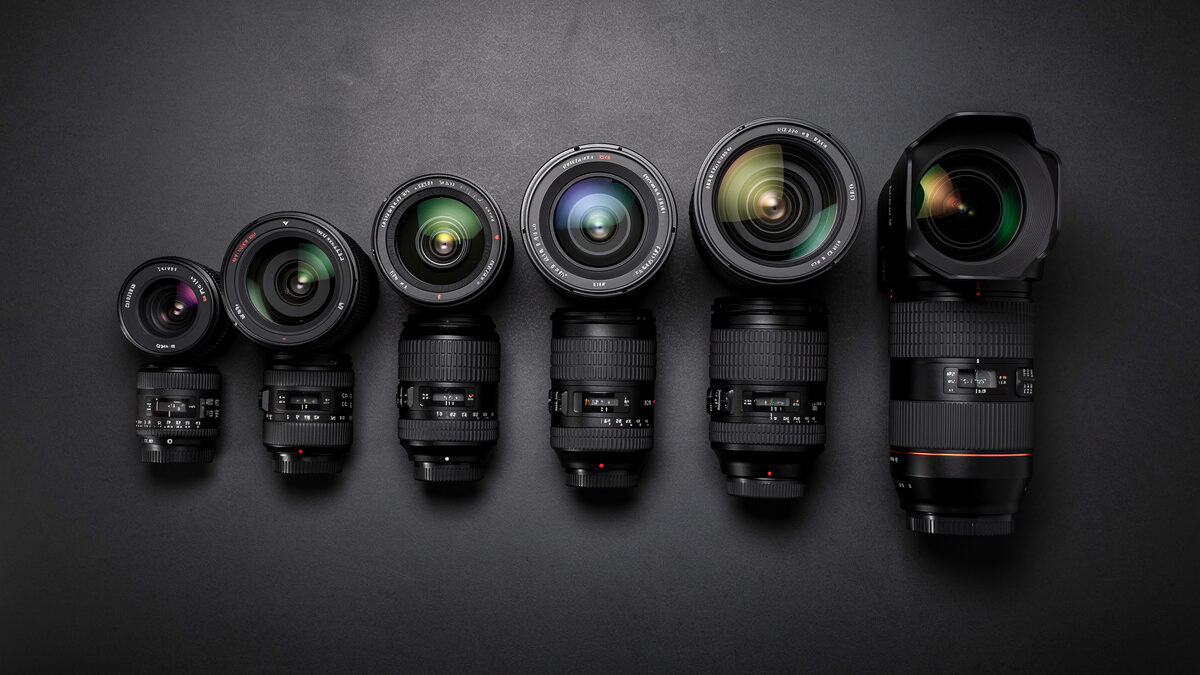
A camera lens is defined by its focal length — and that single number tells you more about what a shot will look like than any body spec ever will. On my Fujifilm X-T5 and Sony a7 IV, I’ve mounted everything from a 10mm ultra-wide to a 600mm super-telephoto, and each focal-length bracket has a job it does better than every other. Here is the complete taxonomy of lens types: what each range sees, what it’s for, what it costs, and which ones have earned a permanent slot in my kit.
Lenses shape images more than camera bodies do. A $900 prime on a $500 body produces sharper, more compelling photographs than a $300 kit zoom on a $3,000 body — I’ve proven this on my resolution chart with the X-T5, whose 40-megapixel APS-C sensor exposes soft corners and chromatic aberration that a 24-megapixel full-frame body would hide. Glass outlasts bodies: I still shoot a 10-year-old adapted prime that renders beautifully, while every digital body from that era is obsolete. Choosing the right lenses for your mount from the start saves thousands of dollars and years of incremental upgrading.
Ultra-wide angle lenses capture fields of view exceeding 100 degrees, creating dramatic perspective distortion that emphasizes foreground subjects against expansive backgrounds. On full frame, an ultra-wide lens is 14mm or wider. On APS-C, the 1.5x crop factor means a 10mm lens provides ultra-wide coverage equivalent to 15mm on full frame — my Fujifilm 10-24mm lives at 10mm for architectural interiors and tight woodland scenes where stepping back isn’t an option.
Landscape and architecture photographers rely on ultra-wide lenses to capture entire scenes without stepping back. The Sony 14mm f/1.8 GM captures star fields with pinpoint stars to the extreme corners — a feat requiring precise optical engineering. The Nikon Z 14-24mm f/2.8 S is the sharpest ultra-wide zoom I’ve seen tested, resolving detail at 14mm that exceeds most prime lenses. For night-sky work specifically, I’ve covered the complete astrophotography lens breakdown in its own guide — ultra-wide aperture matters more there than anywhere else.
Ultra-wide lenses exaggerate perspective. A rock 2 feet from the lens appears enormous while a mountain 500 feet away appears small — the closer element balloons in the frame far faster than the distant one shrinks, which is the entire visual trick ultra-wide landscape photographers exploit on purpose. This creates dynamic compositions but distorts faces when used for portraits — noses appear larger, foreheads recede. Never use an ultra-wide lens for headshot or close-up portrait work. For the Milky Way and astro-landscape side, coma performance at wide apertures matters more than center sharpness — a lens that renders pinpoint stars in the center but comet-shaped blobs in the corners is useless for night skies.
Rectilinear ultra-wide lenses (corrected to eliminate barrel distortion) cost $800-2,500. Fisheye lenses (uncorrected, with extreme barrel distortion) cost $150-800 and create the circular or full-frame warped look used in skateboarding and action sports photography. Most photographers need a rectilinear ultra-wide, not a fisheye — unless you specifically chase that look.
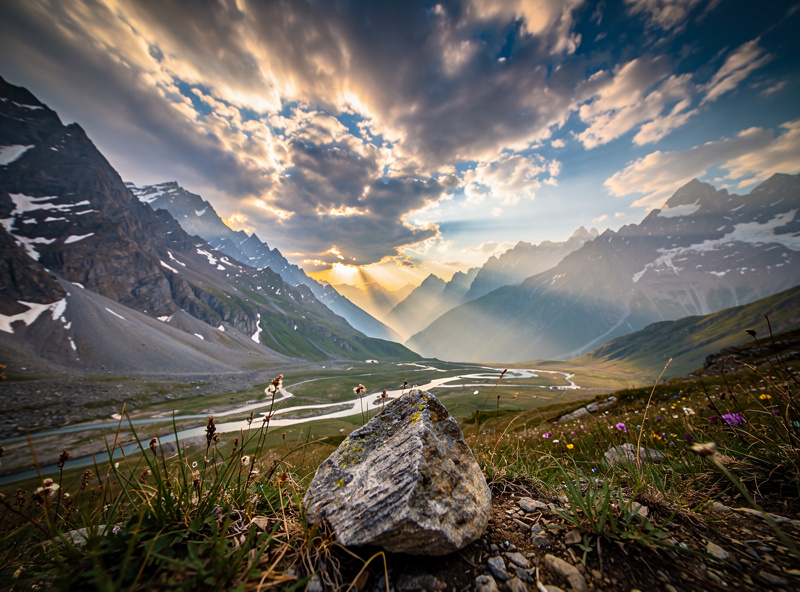
Wide-angle lenses capture 60-100 degrees of field of view, providing environmental context without the extreme distortion of ultra-wides. The 24mm focal length is the most popular wide-angle — it captures enough scene to tell a story while maintaining natural perspective for architecture, street, and environmental portrait photography. My Fuji XF 23mm f/1.4 is the wide I reach for when I want the subject to sit inside a recognizable place, not be isolated from it.
The 16-35mm f/2.8 is the standard professional wide-angle zoom. Canon’s RF 16-35mm f/2.8L, Nikon’s Z 14-24mm f/2.8 S, and Sony’s 16-35mm f/2.8 GM II are the three best options, each costing $2,000-2,300. These lenses cover the entire wide-angle range in a single zoom, replacing 2-3 prime lenses. For travel and one-lens packing, a wide zoom like the 16-35mm plus a fast 50mm prime covers 90% of what you’ll encounter.
Wide-angle primes offer wider maximum apertures at lower cost. The Sony 24mm f/1.4 GM costs $1,400 and captures a full 2 stops more light than a 24-70mm f/2.8 zoom at 24mm — on my chart this translates to clean ISO 6400 where the zoom needs ISO 25,600 for the same exposure. This difference matters for astrophotography (where f/1.4 captures 4x more starlight than f/2.8), indoor event photography, and low-light street work.
Budget wide-angle options exist for every mount. The Nikon Z 28mm f/2.8 ($300) is a pancake lens weighing 155 grams — it fits in a coat pocket and produces sharp images across the frame. The Viltrox 23mm f/1.4 for Fujifilm X-mount ($270) matches the optical quality of Fujifilm’s $900 23mm f/1.4 at one-third the price — I’ve shot them side by side on the X-T5 and the Viltrox keeps up through f/2.8 and smaller, only trailing wide open in the far corners.
Standard lenses approximate human vision, capturing 30-60 degrees of field of view with minimal perspective distortion. The 50mm focal length is called “normal” because it replicates the magnification and perspective of the human eye on full frame. Standard lenses are the most versatile focal lengths — they handle portraits, street photography, travel, food, documentary, and casual shooting. When I test a new body, a 50mm equivalent is always the first lens I mount — it tells me more about the sensor’s character than any other focal length.
The 50mm f/1.8 is the single best lens purchase for any new photographer. Every major manufacturer produces one: Canon RF 50mm f/1.8 STM ($200), Nikon Z 50mm f/1.8 S ($600), Sony 50mm f/1.8 FE ($200), and Fujifilm XF 35mm f/1.4 R ($400, equivalent to 52mm). These lenses cost 10-20% of a camera body and outperform every kit zoom in sharpness and low-light capability. The full prime versus zoom breakdown covers why a $200 prime embarrasses a $1,000 zoom in pure optical quality — it’s not close.
The 35mm focal length captures more environment than 50mm, making it preferred for street photography, travel documentation, and photojournalism. A 35mm lens shows the subject and their surroundings, providing context that a 50mm tight framing excludes. The Fujifilm 23mm f/2 (equivalent to 35mm) on the X100VI compact camera has become the most popular street photography camera in the world — and for good reason: it’s the focal length of reportage.
The 24-70mm f/2.8 is the standard professional zoom — the most-used lens in wedding, event, and editorial photography. It covers wide-angle through short telephoto in a single lens, eliminating lens changes during fast-moving events. Canon’s RF 24-70mm f/2.8L ($2,300), Nikon’s Z 24-70mm f/2.8 S ($2,300), and Sony’s 24-70mm f/2.8 GM II ($2,200) are the three professional options. On my full-frame a7 IV, a 24-70mm f/2.8 lives on the body for walkaround environmental work; on the X-T5, the XF 16-55mm f/2.8 serves the same role.

Telephoto lenses compress perspective and isolate subjects from backgrounds. The 70-200mm f/2.8 is the second most popular professional lens after the 24-70mm f/2.8. It produces the shallow depth of field and background compression that defines portrait, wedding, sports, and event photography. When I need subject separation that a standard zoom cannot deliver — a portrait against chaotic festival crowds, a speaker isolated from a busy conference hall — the telephoto zoom is the tool.
The 85mm focal length is the classic portrait lens. On full frame, 85mm provides flattering perspective for head-and-shoulder portraits — it does not distort facial features like wider lenses and does not flatten faces like longer telephotos. The Canon RF 85mm f/1.2L ($2,700), Nikon Z 85mm f/1.2 S ($2,800), and Sony 85mm f/1.4 GM ($1,800) produce extreme background blur that separates subjects from busy environments. For a full portrait-lens breakdown at every budget, I’ve covered options from $200 to $3,000 in a dedicated guide.
The 70-200mm f/2.8 zoom replaces the need for 85mm, 105mm, 135mm, and 200mm primes for most photographers. Canon’s RF 70-200mm f/2.8L ($2,700), Nikon’s Z 70-200mm f/2.8 VR S ($2,700), and Sony’s 70-200mm f/2.8 GM II ($2,800) are each optically exceptional. Budget alternatives from Tamron (70-180mm f/2.8 G2, $1,200) offer 90% of the performance at half the price. For choosing a dedicated wildlife telephoto, the 70-200mm range is the starting point — beyond 200mm you enter the super-telephoto bracket with its own set of trade-offs.
Telephoto compression flattens perspective, making distant objects appear closer together. This effect is used in landscape photography to stack mountain layers, in urban photography to compress building facades, and in portrait photography to produce flattering facial proportions. A 200mm lens makes a background mountain appear roughly 2x larger relative to the foreground than a 50mm lens from the same position — it’s a compositional tool, not a substitute for walking closer.
Super-telephoto lenses are required for wildlife, bird, motorsport, and moon photography where the subject is 50-500+ meters away. Focal lengths from 200mm to 800mm provide the magnification needed to fill the frame with distant subjects. These lenses are large, heavy, and expensive — the three factors that define the super-telephoto category. My XF 70-300mm gets me to 450mm equivalent on the X-T5, which is enough for large mammals and perched birds; for small-warblers-in-flight territory, 600mm is the floor.
The 100-400mm f/4.5-5.6 zoom is the entry point for wildlife photography. Canon’s RF 100-500mm f/4.5-7.1L ($2,700), Nikon’s Z 100-400mm f/4.5-5.6 VR S ($2,700), and Sony’s 100-400mm f/4.5-5.6 GM ($2,500) cover the most-used wildlife range in a single lens. These lenses weigh 1,300-1,600 grams — heavy but handholdable for 2-3 hour shoots. At 400mm on a full-frame sensor, a standing adult human fills the frame at roughly 25 meters.
The 200-600mm range reaches birds and shy wildlife. Sony’s 200-600mm f/5.6-6.3 G ($2,000) is the best value super-telephoto I’ve seen tested — it resolves sharp images at 600mm for one-third the price of a professional 600mm f/4 prime. Nikon’s Z 180-600mm f/5.6-6.3 VR ($1,800) matches it for the Z mount. On location, the difference between 400mm and 600mm is the difference between “I can see the bird” and “the bird fills the frame.”
Prime super-telephoto lenses (400mm f/2.8, 600mm f/4, 800mm f/5.6) cost $6,000-13,000 and weigh 3,000-4,500 grams. These are professional tools for sports photographers working from fixed positions with tripod support. The optical quality exceeds zoom lenses, and the wider maximum apertures (f/2.8-4 vs f/5.6-7.1) provide 2-3 stops more light for faster shutter speeds. I’ve never needed a $12,000 600mm f/4 for the wildlife I shoot — the 200-600mm zoom class covers it — but if your income depends on publishing images shot at dawn in a forest canopy, those extra stops pay for themselves in keeper rate.
| Lens Type | Focal Length | Field of View | Best For | Price Range | Weight |
|---|---|---|---|---|---|
| Ultra-Wide | 8-16mm | 100-180° | Landscape, architecture, astrophotography | $300-2,500 | 300-700g |
| Wide-Angle | 17-35mm | 60-100° | Street, landscape, environmental portraits | $200-2,300 | 155-700g |
| Standard/Normal | 35-70mm | 30-60° | Everything — portraits, travel, street, documentary | $200-2,300 | 155-900g |
| Short Telephoto | 70-135mm | 18-30° | Portraits, weddings, events, compressed landscapes | $200-2,800 | 300-1,100g |
| Telephoto | 135-200mm | 12-18° | Sports, portraits, wildlife (close range) | $500-2,800 | 700-1,500g |
| Super-Telephoto | 200-800mm | 5-12° | Wildlife, birds, motorsport, moon | $1,800-13,000 | 1,300-4,500g |
| Macro | 60-200mm | Varies | Insects, flowers, product, food close-ups | $400-1,800 | 350-1,100g |
| Tilt-Shift | 17-90mm | Varies | Architecture, product, miniature effect | $1,500-3,500 | 600-1,200g |
Macro lenses focus close enough to achieve 1:1 magnification — filling the frame with subjects as small as a coin, insect, or flower petal. True macro lenses (1:1 ratio) reproduce subjects at life-size on the sensor. “Close-up” lenses and extension tubes achieve less magnification and are not substitutes for dedicated macro optics. The full macro photography guide covers technique in depth — lens selection is the starting point, not the whole craft.
The 100mm macro is the most versatile option. Canon’s RF 100mm f/2.8L Macro ($1,400) includes a spherical aberration control ring that adjusts bokeh character from smooth to nervous — a unique feature for creative close-up work. Nikon’s Z MC 105mm f/2.8 VR S ($1,000) is the sharpest macro lens I’ve seen measured by any manufacturer. Sony’s 90mm f/2.8 Macro G ($1,100) has been the standard for the E-mount macro shooter for years. On the X-T5, a 60mm or 80mm macro at APS-C gives similar working distance to a 100mm on full frame.
Macro photography requires technique beyond lens choice. Focus stacking — combining 10-50 images at slightly different focus points — produces sharp images across the entire subject depth at f/2.8 where diffraction hasn’t yet softened the pixel-level detail. Tripod use is essential at 1:1 magnification because the depth of field at f/5.6 is under 2mm — handholding at 1:1 is a compositional luxury that costs you keeper rate. Ring lights or twin flash units provide even illumination for insect and flower macro work.
Tilt-shift lenses correct perspective distortion in architecture photography by shifting the lens axis parallel to the sensor plane. They also create the “miniature effect” by tilting the focal plane so only a thin strip of the image is sharp. Canon’s TS-E 17mm f/4L ($2,100) and TS-E 24mm f/3.5L II ($1,900) are the standards for architectural photography. Tilt-shift is a niche tool — I’ve borrowed one for a product shoot where converging verticals would have been unacceptable, but most photographers solve keystoning in post with a wide-enough lens and a crop.
Fisheye lenses produce extreme barrel distortion — straight lines curve dramatically, creating the circular or full-frame warped look. The Rokinon 8mm f/3.5 ($250) is a manual-focus fisheye available for every mount. Fisheye photography is a niche genre used in skateboarding, snowboarding, and creative portraiture. Adapting vintage glass to mirrorless is another way to access unique rendering for very little money — a Soviet-era fisheye or a projection lens can produce images no modern optic replicates.
Cinema lenses are optimized for video with geared focus rings, clickless aperture rings, and standardized housing sizes for follow-focus systems. The Sigma Cine line and Sony CineAlta lenses cost 2-3x their photo equivalents but provide smooth, repeatable focus pulls essential for narrative filmmaking. For stills shooters, these features add cost and weight that don’t translate to a sharper print.

Reading a lens name like “Canon RF 70-200mm f/2.8L IS USM” requires understanding four specifications: focal length range (70-200mm), maximum aperture (f/2.8), build grade (L = professional), image stabilization (IS), and focus motor type (USM = ultrasonic). Each specification directly affects price, size, weight, and real-world performance. On my chart, I care about wide-open sharpness and where a lens peaks, because that tells me which aperture I can trust at a wedding versus which needs stopping down for a critical landscape.
Maximum aperture (the f-number) determines how much light the lens gathers and how shallow the depth of field becomes. An f/1.8 lens gathers 2.3 stops more light than f/4 — meaning it can use shutter speeds 5x faster in the same light. A 50mm f/1.8 at f/1.8 isolates subjects from backgrounds dramatically; a 50mm f/4 keeps most of the scene in focus. Faster apertures cost more because they require larger, heavier glass elements. How that aperture renders — whether the bokeh is creamy or nervous — is a separate optical quality that spec sheets never capture but every shooter notices.
Image stabilization (IS/VR/OIS/IBIS-compensating) allows handheld shooting at shutter speeds 3-5 stops slower than the reciprocal rule predicts. A 200mm lens normally requires 1/200 second to avoid camera shake. With 4 stops of stabilization, you can shoot at 1/13 second handheld — a dramatic advantage in low light when tripods are impractical. Nikon’s own VR documentation cites up to 4 stops of correction under CIPA’s standardized testing method — the industry benchmark every manufacturer’s stabilization claim gets measured against, though the real-world number always depends on the specific lens, focal length, and how steady your hands are that day. Stabilization adds $200-500 to the lens price and 100-200 grams of weight. The X-T5’s IBIS paired with a stabilized lens compounds the effect — I’ve shot acceptably sharp frames at 1/8 second at 300mm equivalent, which is well into “shouldn’t work” territory on paper.
Weather sealing protects against rain, dust, and temperature extremes. Professional-grade lenses (Canon L, Nikon S-line, Sony GM, Fujifilm WR) include rubber gaskets at every joint and sealed focus rings. Budget lenses lack sealing and require rain covers in wet conditions. If you shoot outdoors in unpredictable weather, weather-sealed lenses are worth the premium — a single water-damaged lens costs more to repair than the sealing premium. My XF 16-55mm f/2.8 WR has survived light rain and coastal spray repeatedly; the non-WR primes get a rain sleeve the moment the sky darkens.
Autofocus motor type affects speed and noise. Ultrasonic motors (USM/SWM/SSM) focus silently and quickly — essential for video where motor noise records on the audio track. Stepper motors (STM) focus smoothly during video but may be slower for stills. Older screw-drive motors are loud and slow but appear only in adapted DSLR lenses, not native mirrorless glass. Lens filters — UV, CPL, ND — sit in front of all that glass and can either protect your investment or degrade it, depending on quality.
Manufacturer spec sheets usually publish an MTF (modulation transfer function) chart alongside a new lens, and it’s worth knowing how to read one before you trust it. Nikon’s own explainer breaks it down cleanly: the chart plots contrast and resolution from the center of the frame (left) to the corner (right), with a 10-lines-per-millimeter trace showing contrast and a 30-lines-per-millimeter trace showing finer resolution — flatter lines mean more even performance corner to corner, higher lines mean better optical performance overall. It’s a genuinely useful first filter before you buy a lens sight unseen. But it’s still a manufacturer’s own bench measurement, usually at one aperture, often the lens’s best-case scenario — it’s not a substitute for putting the lens on your own body and shooting your own aperture sweep. That’s the whole reason I keep a resolution chart on my wall instead of trusting a spec sheet: the MTF chart tells you what the lens should do in a lab, and the aperture sweep tells you what it actually does on your sensor, at your apertures, with your copy of the glass.
A practical starter lens kit consists of three lenses covering wide-angle, standard, and telephoto ranges. This three-lens kit handles landscape, portrait, street, travel, event, and basic wildlife photography. Total cost ranges from $500-3,000 depending on whether you choose budget or professional-grade glass. I’ve built and rebuilt kits across two mounts; every time I’ve tried to skip the standard prime to save money, I’ve ended up buying it within three months.
The budget starter kit costs $500-800 total. It consists of a 50mm f/1.8 prime ($200) for portraits and low light, an 18-55mm or 24-70mm f/4 kit zoom ($300-500) for general shooting, and a 55-200mm or 70-300mm telephoto zoom ($200-400) for distant subjects. This kit produces professional-quality images in daylight and acceptable images in moderate low light. The 50mm f/1.8 is the lens I hand to anyone asking “what should I buy first?” — regardless of brand or mount.
The enthusiast starter kit costs $1,500-2,500 total. It replaces the kit zoom with a 24-70mm f/2.8 ($900-1,500), adds a 50mm f/1.4 or 85mm f/1.8 ($400-800) for dedicated portrait work, and includes a 70-200mm f/4 or 70-180mm f/2.8 ($800-1,200) for telephoto work. This kit matches professional output quality for all but the most demanding commercial assignments. On the body side, choosing the right camera for your glass matters — a full-frame sensor gives those f/2.8 zooms the depth-of-field advantage they’re designed for.
Buy the standard zoom first, then add the prime for low light, then add the telephoto. This order ensures you always have a versatile option available while building toward a complete kit. Avoid buying all three lenses at once — learning one focal length deeply before adding another builds stronger composition skills than juggling three unfamiliar lenses.
Rent before you buy anything above $800. Lensrentals-style services and local camera stores let you put a 400mm supertelephoto or a $2,000 85mm f/1.2 on your own body for a weekend before committing — I’ve rented telephoto glass for a single wildlife trip rather than owning a lens that would sit in a drawer 50 weeks a year. This matters most for specialty glass: tilt-shift, super-telephoto, and exotic apertures are exactly the lenses photographers buy on hype and then barely touch once the specific project ends. A three-day rental costs $50-150; buying and reselling at a loss costs hundreds. If you rent the same focal length three times in a year, that’s your signal to buy — the usage pattern tells you more than any review ever will. I’ve done this backward exactly once: bought a specialty macro lens on enthusiasm, used it twice in a year, and sold it at a 35% loss. Renting first would have told me the same thing for the cost of a weekend, not a mistake I had to eat.
Photography is the meta-hobby that records every other hobby I’ve built — without it the welding rig, the hydro system, and the leather workbench would be invisible — and the lenses are how that record gets made.
The 24-70mm f/2.8 is the most versatile lens, covering wide-angle through short telephoto in a single optic. It handles 80% of photography scenarios including portraits, events, travel, and street. The second most versatile is a 50mm f/1.8 prime, which excels in low light and shallow depth of field at one-tenth the cost.
Every photographer should own a 50mm f/1.8 prime ($200-600). It teaches composition by forcing you to zoom with your feet, produces sharp images with beautiful background blur, and handles portraits, street, travel, and low-light photography. It is the highest-value lens in every camera system.
Camera lenses contain 10-20 precision-ground glass elements with nano-coatings, ultrasonic autofocus motors, and image stabilization systems. A 70-200mm f/2.8 has over 150 individual components assembled to tolerances under 1 micron. The optical glass alone costs $200-500 before assembly. Professional lenses also include weather sealing and metal construction.
A 24-70mm f/2.8 or 24-105mm f/4 covers the widest practical range for general photography. However, these lenses cannot match the low-light performance of fast primes (f/1.4-1.8), the reach of telephoto lenses (200mm+), or the magnification of macro lenses. Most photographers need 2-3 lenses to cover their primary genres.
More expensive lenses typically offer wider maximum apertures, better corner sharpness, faster autofocus, weather sealing, and more durable construction. However, a $300 50mm f/1.8 produces images indistinguishable from a $1,500 50mm f/1.4 at f/2.8 and smaller apertures. The premium price buys low-light performance, build quality, and autofocus speed — not better daylight images.
Prime lenses have a fixed focal length like 50mm while zoom lenses cover a range like 24-70mm. Primes are typically sharper, lighter, and have wider maximum apertures at lower cost. Zooms offer convenience and flexibility, covering multiple focal lengths without lens changes. Each has trade-offs covered in the full prime vs zoom comparison.
Start with two lenses: a 50mm f/1.8 prime for portraits and low light, and an 18-55mm or 24-70mm zoom for general use. This two-lens kit covers 90% of photography scenarios for under $500 total. Add a telephoto (70-200mm or 70-300mm) when you need reach for sports or wildlife.
I’ve chart-tested both primes and zooms across my two mounts — Fuji X on the…
The best lens for food photography is a short macro (60–105mm equivalent) or a normal…

After charting every portrait-length lens I own across two mounts — the Fujifilm XF 56mm…
Leave a Reply